
TashWord
Tash is a professional writer who loves helping people communicate clearly and effectively.

Do you find the use of capital letters bewildering or frustrating?

Distractions made it hard to read – and poor grammar can be a distraction
Some people struggle with the questions ‘does this word need a capital letter?’ and others use so many unnecessary capital letters that just frustrate readers – excess capital letters actually make text harder to read (and more time-consuming to write, too!)
Some competition terms I recently read confused me because of a poor capital letter use. By adding a capital letter mid-sentence, I thought it was missing a full stop and a new sentence had started – but reading it as a new sentence didn’t make sense.
Entry is open to all Client bookings made with…
What do you think – did the capital C for client distract you?
In my mind, if you have to reread a sentence to understand it, the writing has failed. Good writing is easy to read and lets the reader focus on the message, not the words. {Obviously it’s different if you reread it because you can’t understand a difficult concept!}
Presumably, lack of clarity in something like competition terms or a contract has potential legal implications.
* Photo courtesy of 123RF
Quality vs quantity – this question comes up many times in life, and the answer can vary between situations.
So what do you think is important for social media?
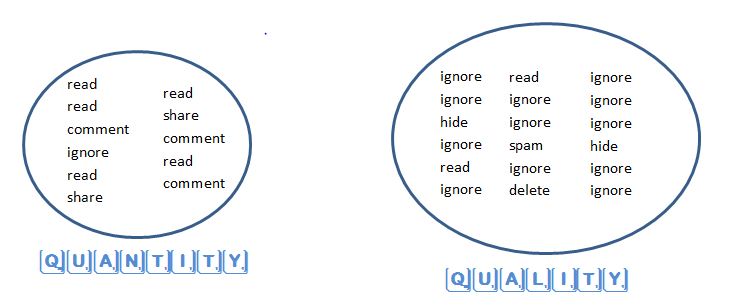
Some of my thoughts about quantity vs quality of social media followers
Is it a matter of ‘she with the most social media followers wins’?
How far can you go to get new followers – should there be boundaries or just get as many as possible?
Or is it better to nurture a smaller number of followers who actually are interested in what you have to say?
Quality followers, to my thinking, are those who will read my updates, maybe respond or follow through on links, and hopefully share my comments and/or links.

You can give a quality audience a hands-on approach
Quality followers are the ones worth building a relationship with – and that’s easier with a smaller number, too.
I don’t think you can get quantity and quality.
That is, you can get a lot of quality followers and growing your base is not a bad thing in itself. But if you focus on getting many followers the odds are many will not be quality followers and are just there because they were paid or get some other benefit from it.
Like anyone, I like to see my followers increase in number (there’s a bit of that school yard popularity desire in us all I think!) but I don’t make it my priority. I prefer to gain followers who genuinely want to hear from me.
Which strategy do you prefer?
Do you think it varies with different purposes of a social following?
The obvious technique is to provide quality content on your social media platforms.
I won’t follow anyone (no matter how popular they are or how important others tell me they are) if their social media pages are full of boring chatter or self-promotion. If I’m going to invest my time reading their updates, I want them to be worth reading. So I assume my followers (and potential followers) feel the same way.
Not every update will be awesome, and some chatting is also good, but the bulk of the updates need to provide some sort of value – even if I can see the value despite it not applying to me at that time.
Asking people to connect with you in social media is fine – to a point.
On platforms like LinkedIn or Facebook, you can only connect with an individual (as distinct from a company page) by inviting them to be a contact. But I resent getting invitations from complete strangers who don’t even bother to add a note to the invitation. A friend can get away with that, as I know who they are, but why I should I connect with a stranger? Especially a stranger who is giving the impression that spamming is ok – I don’t want connections who will bombard me with nonsense.
My advice – if inviting someone on LinkedIn, add a few words to show you are a real person asking and that you know who you are asking. For best results, show how you can give them some value for connecting.
[Tweet “Give people a reason to connect with you”]
Gary Loper recently tweeted “Begging people 4 a RT is sitting on a corner begging 4 change. Let peeps RT u naturally”. And I have to agree – I don’t like tweets that ask to be retweeted and have never retweeted one – including some that I was inclined to retweet until I saw the request (yes, I can be stubborn!) If someone likes my tweet, they’ll share it anyway is my thought. Asking is like young children asking ‘will you be my friend?’ or asking a stranger to pay for your lunch.
Yet I have heard statistics suggesting asking for a retweet increases the chances of being retweeted. I don’t understand it, but there you go!
How do you build your social media followers? Are you focusing on relationships or numbers of followers?
* Images courtesy of Word Constructions and 123rf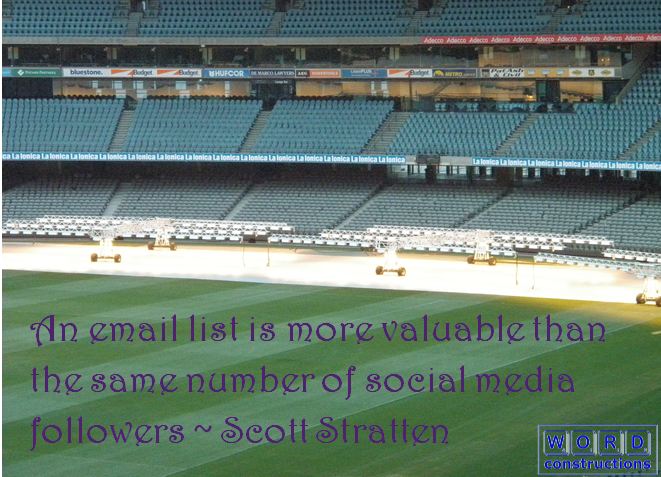
paraphrased from Scott Stratten, author of The book of business awesome and Unmarketing. top marketing and start engaging[/
Yesterday, I heard Scott Stratten talk about business awesomeness in a webinar run by the Australian Businesswomen’s Network (ABN) and the above statement stuck in my mind.
For many years, building a list was the key to online success according to many marketers and people worked hard to get more email addresses.
Now, the list isn’t mentioned as much but there is much talk of being on social media – and some will certainly imply or say that the more followers the better.
Is it just a sign of the times that social media is taking over from email lists and html newsletters?
Scott uses the term fractional reaction to show how limited social media exposure can be.
Let’s say you have 100 Twitter followers and you tweet something important at 1o am. How many of those followers will be watching their Twitter feed at 10am? If they are not looking, there’s a very good chance they won’t see your tweet. How often do you go back very far in your social media feeds to check you haven’t missed something?
On the other hand, if you send an email at 10am and I’m offline, it will still be in my inbox when I get online.
Email or social media, I may ignore your message because there are too many things to choose between or because it doesn’t interest me. But Scott is saying more will at least see your email. And your email has more chance of being opened if you have built a reputation of sending emails worth reading.
Of course, the other advantage of an email list is that it is yours.
And thus you have control over contacting those people to build your relationship and business.
If you have tried both email marketing and social media marketing, which has given you the best results?
It really isn’t easy to put a (return on investment) ROI on social media as some it is based on relationship building, gaining credibility as a thought leader, exposure and learning as well as direct marketing – social media doesn’t work just as a marketing tool.
Social media can take a lot of time to make regular posts, although often in short bursts, whereas writing emails tends to take bigger blocks of time.
With the use of automated emails, the same email can be used over and over in a way that just can’t apply to social media.
If you leave a social media platform or it stops, you lose those followers. Likewise if the platform changes rules, you may find it harder to stay in front of your followers – for example, if they start charging.
I hadn’t really thought about comparing the two options before hearing Scott yesterday. Yet I can see a lot of wisdom in his words.
Of course, there is no reason to not build both an email list and a social media following but which is worth more time and effort? Is a social media following worth pursuing at the expense of your email list?
I know I have put less effort into building an email list than I used to – and now I am rethinking that. Something to consider at my next working on my business session!
Is this a new perspective for you, too?
Obvious plug – you can join my email list and subscribe to my monthly newsletter and/or see below to subscribe to my blog posts and comments.
We need down time, even from our favourite things.

Like a young child playing with new toys, we all like to play with our new tools and gadgets. Are we also like young children that we need a rest from our toys/tools?
Having done the research into online chat, I was introducing it to some of my client’s employees the other day.
One of the employees – let’s call him Simon for simplicity – liked the idea of offering it to their customers but asked some really good questions.
Won’t we need a dedicated person to manage the online chat? None of us have time to take that on.
What happens if the online chat person is on the phone or something when someone wants to chat?
There’s no doubt that adding a new feature or tool can create extra work in the short-term. It takes time to set up and learn how to use it, and you may have to explain it to a number of people before it becomes fully effective.
I don’t think adding online chat means getting an extra person into the workplace. Even in a busy customer service business, the online chat should reduce the number of phone calls and emails which would free up the time needed to answer chats.
For Simon, I was able to explain that a little pop up window will show to all relevant staff when someone wanted to chat so any available staff member could answer.
Another reassurance for Simon and his team was that online chat doesn’t have to be on all the time.
While there are variations between online chat systems, my client will have a choice between making the chat feature invisible or showing as offline to collect an email address when staff are unable to accept chats.
I think that’s important.
So many great new tools are offered to businesses but we need down time – to do our work, to undergoing training, to have a break and so on. Whether it is joining social media, online chat, a eShop or other tool, we need to be able to turn it off in some way.
How often do you turn off social media, emails and similar communication tools?
What if you had online chat on your site – would you turn it to offline even if you are physically present? Turn it off out of business hours, even if you can use it while mobile?
* Image courtesy of 123RF
Deciding to add live chat to your website is just step one – deciding on a supplier can be time-consuming. Reviews of suppliers can aid your search…
Since writing my review of online chat options last month (was it really that long ago?), I’ve done more testing and refining. And then another option caught my eye, despite having stopped looking, and I’m really impressed with it so I’m adding this to the list…
** Unlike the other options I reviewed, assistro not only has an affiliate program but is also worth mentioning via that affiliate program s0 the links to their site may result in an affiliate payment to me if you choose their paid service – it won’t cost anything extra for you either way.
Today’s meanings were inspired by a blog post where the word waist was used instead of waste. In this instance, I pointed out the error and the blogger was able to fix the post.
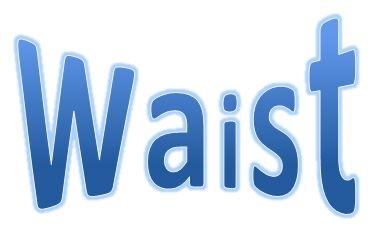
A waist goes in, like the provernial hourglass figure, so maybe this image will help you remember which wasit to waste!
waist {noun}: the area bewteen a person’s rib cage and hips; the narrow area of any object that widens at both ends; the part of clothing that covers or sits on a person’s waist
Women used to wear corsets to have a smaller waist than was healthy.
waste {verb}: to use, consume or lose something carelessly or thoughtlessly
Being careless about turning taps off leads Jack to waste a lot of water.
Don’t waste bloggers time when offering guest posts.
Hmm, so how to remember which waist/waste is which? Just think of that little i in the middle of a waist being like the smaller part of a shape.
Do you think email addresses should be hidden or open to your clients or members?
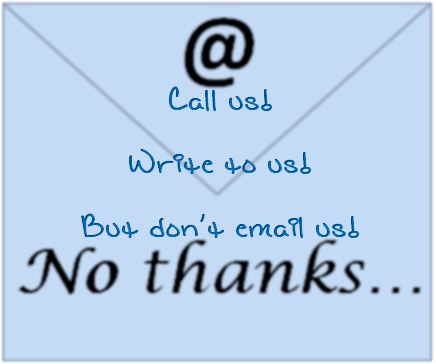
A business making it hard for customers to email them just doesn’t make much business sense to me. Yet that’s exactly what one organisation is doing to their members…
Today, I received an email from an organisation I’m a member of. {Disclaimer – I am only a member there because I haven’t made the time to move elsewhere – that time is now a high priority.}
I did not like today’s email – I mean it was laid out ok and was polite and appropriate as far as the wording went, but I am not happy with the content. Largely because it showed that organisation is using member money to fund something completely unrelated, public and providing no obvious benefit to members.
I hit reply to tell them what I think. I doubt my voice will make a huge difference but I would feel better to be honest about it.
However, the email comes from a no-reply address.
Instead, I went to their website to grab their email address to use instead, but they only have an online form. So I even went as far as checking some letters they’ve sent me in the past – also the contact form URL instead of an email address.
So I can’t reply to the email.
And I am left feeling they are hiding from members. Feeling they are hiding from complaints. Feeling a bit uncomfortable and like I’ve touched something dirty with the way they are keeping contact details secret.
Spam is awful – I hate it. So like many others I avoid putting my email address online in a way that spam bots can find it.
Yet that doesn’t mean my email address is hidden completely.
It is on my business cards, letterhead and certainly is the ‘reply to’ address for my html newsletter.
Other organisations put their email address on their site as a graphic – bots being unable to read graphics (well, so far anyway!) – or in words (eg write AT wordconstructionsDOTcomDOTau is an acceptable way for me to share my email address online.)
And it’s not like I’m talking about a small organisation that can’t cope with emails – a sole trader or other SMB may need to manage contact options, but a big business has more staff and even dedicated staff for customer service.
What do you think?
Are they protecting themselves from spam or from complaints? Are they hiding their email address, even from members, or is it a reasonable business decision?
And I’d love to hear what you have done to promote or hide your email address, too.
What opportunities are you missing by taking things for granted?
I am not an expert in Microsoft Excel but I can use it competently and am aware of its capabilities even when I don’t use some features.
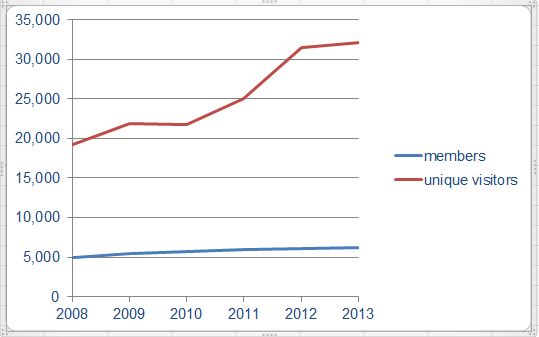
This simple graph was produced from a table of data in excel for one of my clients. For me, it was an obvious way to produce a graph; for my client, it was a major challenge to know how to produce it at all.
And it hadn’t occurred to me that someone who uses Excel for various tasks wouldn’t know that you can easily create graphs from the data entered into Excel. It’s just obvious to me so I took it for granted that it was obvious to others.
Yet, that isn’t the case.
A couple of weeks ago I did a presentation which included a simple graph on one slide. Afterwards, I was talking with a client and he mentioned wanting some graphs for a report he was working on.
Long story short, he didn’t know excel would do that for him.
I set up that simple graph for him and now am managing a larger excel-based project for him. I say managing because it is a more complex graph so I have outsourced it to someone I know who is an Excel expert!
It has me thinking though. How many more graphs could my client have used, in reports or presentations or for his own use, if I had told him about excel graphs sooner?
How many clients could I have referred to my excel expert?
When we know something, it’s hard to remember that many others don’t know it or at least know it as well as well as we do.
Are there some obvious tasks or skills you aren’t seeing for your business?
I wonder what great opportunities you could find by spotting those obvious tasks and skills…
There are always two sides to a coin, two side to a story and two perspectives to view things by.

Which perspective do you chose? Or does it depend on the sides of a coin?
On Tuesday, the Federal Budget was announced.
I’ve read quite a few summaries of the Budget so I can write updates for clients. Some are better than others, of course.
However, my point relates to how small business is impacted by this Budget. Noting that small business got very little direct mention by the Government in this budget.
A number of business groups have released their view that Government ignored this significant sector of our economy. As advocates of this diverse group, they are annoyed because small business don’t appear to have been included.
Yet another business group or two has put out the view that small business was lucky to have avoided the attention big business got in the Budget. I for one am glad we don’t have to report PAYG each month, for instance.
Both views are based on the same fact (little mention of small business) but are looking at it in different ways. I found that very interesting.
While there are a few tasks you can outsource when preparing an annual report, one I love is checking edits.

Early drafts may contain a lot of edits!
That is, when the designer returns a draft to me, someone else goes through and checks the designer has implemented all the changes I requested.
Why check everything? Well, I trust the designers I use, no question about that. However, they are human so may have missed something or misunderstood what I wanted. Or they could have made a simple error (eg made $654 into $664 instead of $646).
Having someone else check those details has two major advantages in my eyes:
I guess you don’t need to find a highly skilled person to outsource checking edits, either – as long as they are detailed orientated, it isn’t a hard task. I am lucky to have found someone I trust for many tasks as he not only checks edits have been made but will suggest other potential improvements he notices, too.
To me, this is the perfect example of outsourcing and leaving me more time to use my writing skills.
What is the perfect task for you to outsource?
Do you outsource that task?
Recent Comments