I hope you find my writing and business tips and observations useful. My business and blog are dedicated to helping businesses communicate clearly and reach their potential.
Read, and enjoy!Tash

Consistency includes contacts
Consistency is an important aspect of building your brand. It is easy to remember to always use the same colours, fonts and logos, but you also need consistency in the details you provide.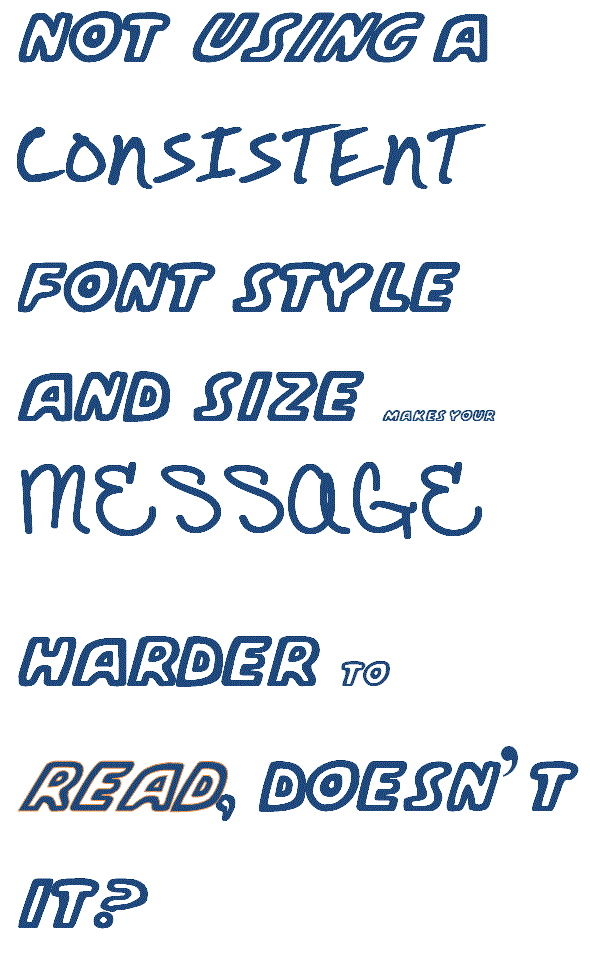
For instance, I recently received an email where the sender’s email address was different to the one in the signature (and I mean completely different – names and domains varied!) and both were different to the URL of the business! I didn’t try any of them and deleted the email…
Contact details are not only important for branding and consistency, they are also crucial in building trust. A business that uses a different email address to what they advertise or refuses to give any contact details on a website and so on can give the impression of hiding something – not a great way to establish trust.
Personally, I also notice when people use an email address that doesn’t match their URL. For one thing, why lose the promotional advantage of using your own domain name? And why promote someone else’s business instead? Using a different domain to your own also looks unprofessional – especially if it is a hotmail address.
What do you think of a business that doesn’t have contact details consistent with your domain? Does it impact on your sense of trust?
Attitude to mistakes
How do you deal with making mistakes? Do you accept that you are going to make mistakes when dealing with clients, and consider how to deal with the aftermath?
I came across a blog post by Danielle Keister where she advises new VAs that they will make mistakes. I love her attitude and her honesty in warning people that they will make mistakes – “Someone who says they never make mistakes is a liar (or delusional).”
What really caught my eye, though, is her ‘speech’ to prospective clients. She basically tells them that mistakes may occur despite her best intentions but that she will also work at fixing them as soon as she is aware of them. Her ideal business relationship is built on trust – people trust her to do the job and fix mistakes and she trusts them to be honest and give her feedback.
I have never written out my attitude about mistakes like Danielle, but I think what she has written is close to what I would write for myself. As a writer, I often deal with feedback from clients and fully expect that to occur – together, clients and I get the best result for their needs as I have the communications skills and they know their brand, business and customers best. This is why my quotes often include a certain number of edits.
Of course, that feedback is not often based on me making a mistake but on technicalities in content, personal preferences and unclear objectives. When it is my mistake, though, I apologise and do my best to quickly rectify the situation. I do that naturally out of a sense of pride and professional integrity.
Additionally, I know that I prefer a supplier to be honest and admit their mistakes to me – I am less likely to return somewhere that makes mistakes but denies or hide them. So it is a business decision to deal with mistakes openly, too.
Given that we are all human and make mistakes, do you have a policy or guideline for dealing with mistakes once you are aware of them?
Keep your website looking fresh
Have you ever come across a website that is obviously out dated? What do you think of it when you do?
I recently came across two extreme examples of this…
- under the heading of ‘latest investment news’ was a link to some reports with the most recent dated April 2008!
- an online shop had banners and text stating ‘new version to be released mid 2009’
Those sites didn’t impress me at all!
While adding content regularly is good practice for a website, there are also some ways to avoid your content being obviously old:
- avoid ‘page last updated’ foot notes – even if it is perfectly reasonable to not update contact details for example, it looks wrong to say that page is 5 years old! Add a date to the content itself if it needs the date for context
- avoid adding a date to copyright symbols. Although your copyright applies from when you created the page, a date ages the page and it is easy to miss updating it each January
- if you are unsure of when something will happen, be vague rather than specific. So ‘new version underway’ or ‘give us your details and we’ll contact you when the new version is available’ are better than ‘new version launched 1 July’
- do a search of your site for ‘2008’, ‘2007’ and so on then make sure you update as appropriate
- be careful of what tense you write in. For example, ‘from 1 July we will sell whatsits’ will be dated in August whereas ‘whatsits on sale from 1 July’ can be used in June and August. Adding a year to either sentence will date it if you leave the text for more than a few months, of course!
the artifice of an artisan
artefact: any object made by humankind
The archeologist was excited to find some artefacts in the cave.
artisan: a skilled craftsperson or manual worker
A number of artisans can be seen at work behind their market stalls.
artifice: contrivance, cunning, skilled trick; skill
The conman’s artifice had fooled many people in the last five years.
artificer: inventor, skilled crafts person; skilled mechanic (in miltary and naval usage)
Da Vinci is one of the most famous artificers in European history.
Remember the artefact is the object made by the artisan, who might show some artifice in the process.
Which punctuation mark do I use?
Sometime when using quotation marks at the end of a sentence or phrase, it would seem that two punctuation marks are required (one for the quote and one for the sentence).
However, you only ever use one punctuation mark, whether it is a full stop, exclamation mark, question mark, or anything else, at the end of a sentence.
In order to know which one to use, consider which is more powerful and use that one.
Some examples:
The teacher yelled out ‘Quiet!’
Did you say ‘John will fix my car’?
Someone might wonder ‘why did he choose that colour?’
Together we all …
Although they sound exactly the same, the word altogether and phrase all together are quite different.
all together: at the same time, acting in unison
All together, 50 students visited the display.
altogether: completely, entirely
The recipe was altogether different to my version.
The simple way to remember which is which is to think of all the parts being together – all together.
Check questions are answered
Clear writing needs to flow so that each statement or each point you make follows on the previous one. As soon as your reader has to stop and think about how the ideas connect or gets confused from a jump in topics, your message is weakened.
It is especially important to directly answer any questions you may raise at the start of any communication*. For example, if the title to your article is ‘retire now or later?” then the article must give information about when to retire; if your article is really about building your super by retiring later, use a title such as ‘super and delayed retirement’ or ‘retire later with more super’.
Likewise, if you include the question ‘should I have a blog?’ you need to include positives and negatives to help a reader make an informed decision; if you just want to list advantages to blogging, use ‘ 10 good reasons to have a blog’ as the topic.
As well as being effective writing, answering questions you raise
- gives you the opportunity to show (and share) your knowledge
- allows people to quickly find what they are after (which they appreciate)
- gives you a structure that makes the writing easier
- avoids annoying readers with irrelevant information and misleading titles wasting their time
* Of course, this applies to informative writing – if you are asking questions to gather interest, don’t give an answer but you still need to ensure the question and following information are obviously related. For instance. “Too busy to cook from scratch?’ needs to be followed by ‘our recipes give you quick, nutritious meals’ or ‘our flavour sachets save you time and effort’, but not by ‘Whatsit Saucepans are dishwasher friendly’
reforestation
Sometimes words don’t have to sound alike to be commonly swapped with another word of different meaning. For example, reforestation and afforestation are often misused – note reafforestation (also used by many people) is not a word at all!
afforestation: planting trees/seeds to make a cleared area into a forested area
Afforestation is slowly reducing the size of the desert.
reforestation: replanting trees/seeds to replace a forest after fire or felling
The timber company is involved in reforestation after every logging project.
Maintaining the flow of ideas
Writing with disjointed ideas that don’t flow from one to another is not easy to read and not a good advertisement for you. So how can you make your writing flow?
- My first tip is to proof read everything you write – preferably after a decent break from it and by someone else for anything important. It is easy to write down things as they occur to you but reading it later will show the lack of flow
- Qualify any alternative perceptions, usually words such as although, however, despite and but will help things flow better. For example “I think chocolate is best. Caramel has more flavour” doesn’t flow as well as “I think chocolate is best although caramel has more flavour.”
- plan your messgae before you write it – if you know what each paragraph is about before you start, you are less likely to include irrelevant material
- Remember that you don’t have to include everything you know about a topic in one piece of writing (even a thesis will have appendices and refer to external material!) Trying to include every fact and all points of view often leads to disjointed results so just include the details relevant to your purpose
- Check each paragraph covers only one idea and then review the order of the paragraphs so that information builds on itself and related ideas are in subsequent paragraphs. The beauty of word processing software is that you can move paragraphs and sentences around easily until they are in the right order for ideas to flow – not as easy to manage with pen and paper or a typewriter!
Is maintaining the flow of ideas in your writing something you consciously work on?
Keep ideas flowing
Have you ever read something and found a jump in ideas that distracts you?
I find it really annoying when the ideas don’t flow in a piece of writing – the change of topics or tense or perception may not seem major but if it makes me have to reread something to understand what happened, I tend to lose interest in the whole thing.
I came across the following example of this on a website where it is promoting cheap ‘reports’ to help small business people; the errors give me the impression of low quality pdfs rather than informative reports – what do you think from their description?
Too often I visit the site of a business mum to find there is only a contact form! The main reason I visit the site is to see where they are located as, where possible, I prefer supporting local business mums. There are a lot of different reasons for the lack of contact details.
This weeks *** report will look at five different contact methods you may want to put on you site as well as options for phone numbers, fax numbers, postal address and email address.

A range of contact options are available
Yes, there are various reasons for not including contact details but how is that relevant when you are telling me how annoyed you were at not seeing any contact details! It also has no relevance to the next paragraph so makes the whole thing very disjointed.
I suspect they are attempting to not offend people without contact details rather than standing strong with their own argument. However, it has backfired with poor writing and an indication of weakness that detracts from their ‘expert’ stand in the report.
Here’s an alternative version that won’t offend, sound weak or be hard to read*:
Too often I visit the site of a business mum to find there is only a contact form! I understand they may have their own reason for not including contact details, but the main reason I visit the site is to see where they are located as, where possible, I prefer supporting local business mums.
This weeks *** report will look at five different contact methods you may want to put on your site, as well as some low-risk options for showing phone numbers, fax numbers, postal address and email address.
Having said poor flow of ideas is distracting, my next blog post will include some tips on how to maintain the flow…
*My changes are in blue to improve the flow plus some necessary improvements to the second paragraph so it makes sense. I didn’t totally rewrite it as I would for myself or a client!
Recent Comments