

Welcome!

I hope you find my writing and business tips and observations useful. My business and blog are dedicated to helping businesses communicate clearly and reach their potential. Read, and enjoy!Tash

Refer to older posts…

Blogging services

Writing enticing headings

The headings you use in blog posts, tweets, articles, ads, media releases and the like are a critical aspect of your ongoing success. This also includes sub-headings, titles of tables/images and other stand-out text.

Busy people will only read on if the heading promises something they value right now.

People surfing the internet will only read more if your heading catches their attention, and holds it.

So it is worth putting some effort into making your headings enticing so you maximise the number of people reading whatever your heading leads to. Here are some tips on making your headings more effective:

  • where feasible, use ‘you’ to personalise and catch attention. It also helps you to remember to make your message aimed at your audience
  • apply ample alliteration 🙂 Repeating a letter is attention grabbing which gives your headings more impact.
  • use questions – it is like building some suspense as people are interested in learning the answer
  • be interesting or unusual, possibly even a little controversial, within the bounds of the message and brand you are portraying. This can be as simple as choosing a less common word such as Clydesdale instead of horse or scoop instead of update, or taking a different approach to a common subject (eg. ‘finding quirky blog content ideas’)
  • include a number to introduce a list, such as 5 tips to support email marketing
  • make an offer they can’t refuse like “the secret of getting twitter followers” or “meaningful posts people love to read
  • keep it short – two-part and too long headings are not as visually appealing and don’t belong in any form of marketing, especially not digital media where short works best (consider the 140 character limit on Twitter!)

Can you remember any effective headings? Do you know why it was effective?

The value of guest blog posts

A few days ago, I raised the question of reading guest blogger posts in a favourite blog.

I think there are a number of reasons to value a guest post in a blog, although I do agree that too many guest posts could detract from the person I visit that blog to hear from.

If the guest blogger is filling in for my favourite blogger so that I continue getting content, that consistency and committment is of value to me. Of course, this is of less importance if the blog is erractic in providing content anyway, but we’ll ignore that for the moment!

Assuming that the blog has carefully selected any guest bloggers and the topics they post on, then the guest posts could provide me with an alternative point of view which can be really useful. It could also provide me with a new blog to read and gain information from.

A different person writing may also inspire different people to comment on my favourite blog which again can lead to new conversations, ideas and leads.

And on a more superficial level, if I comment on a guest blogger’s post, that guest blogger may then know of me and my blog…

While there are obvious advantages for the host and guest bloggers, I think guest blogging also holds advantages for the readers. What do you think?
Getting marketing emails read

While there are a number of factors involved in a successful email campaign, I think there are two important points to remember in every marketing email you send out.

1. keep it short – no one is going to read an email that is full of text for pages. Keep sentences and paragraphs short and as few of them as possible, then use white space and images to make it look appealing and quick to read.

2. focus on getting them to do something – usually the call to action is to phone you or visit your website as that is where you can then provide a lot more information

Include everything you should…

I just read a newsletter that arrived a couple of days ago and spotted a huge error. They provided a recipe, introduced it, gave the heading of ingredients and then listed the nutritional value and method. Literally.

In other words, not one ingredient was listed – some were explained in the recipe itself but most didn’t have quantities listed and ‘dry ingredients’ could include a few things!

So learn from their mistake and check you always include all the important details – then check again as part of your proof reading!

Decluttering your blog

Last week I found a blog post I just have to share – Skelliewag gives 50 tips for decluttering your blog (yes he posted this list a while ago, but it still applies as far as I’m concerned!)

He raises some great points, such as not including stats (as you rather than your readers care about them) and irrelevant social media conversations in your side bar. And I love his suggestion of having a traditional links page if you really want to list a lot of blogs somewhere.

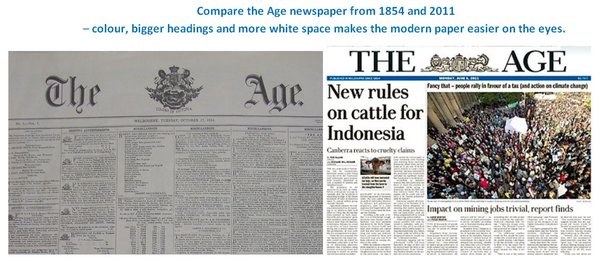
Comparing The Age newspaper in 1854 and 2011 - more white space and colour makes it easier on the eyes

Why declutter a blog?

Having less stuff around your writing gives more white space and less visual distraction – maybe I’m biassed, but I think that is better for highlighting your content. I do think about where to put things on my blog and avoid having too many plugins, but I hadn’t thought of decluttering like this before reading Skelliewag’s post.

One interesting point was to have a categories/tags cloud OR a categories/tags list – not both. I think that both is excess information, especially if you want to declutter and have more clear space around your blog. Personally, I would choose the list because it takes less space and is visually less cluttered than the cloud. On top of that, the cloud is based on bigger text on most popular words/phrases meaning that those words will give you a long list of posts to search through if trying to find something specific. Have you ever clicked on one of those clouds to find anything anyway? I know I haven’t (in fact I actively ignore them, but that’s just me!)

And I like the logic of getting rid of any advertising that doesn’t really pay well – it is nicer for readers to see fewer ads and does make the remaining ones more effective. I find a lot of ads in a blog distracting and prefer to see a clean page focussed on the content, so it makes sense to me to use fewer ads.

Most of his points already apply to my blog, phew! I will review the rest of his list and make decisions on whether to keep or lose some details. So if you think my blog is too cluttered or want something removed, now is the time to tell me!


* Images courtesy of Dysprosia and WikimediaCommons

Be professional with the little things…

It amazes me sometimes how people ignore some of the little details that are so easy to deal with.

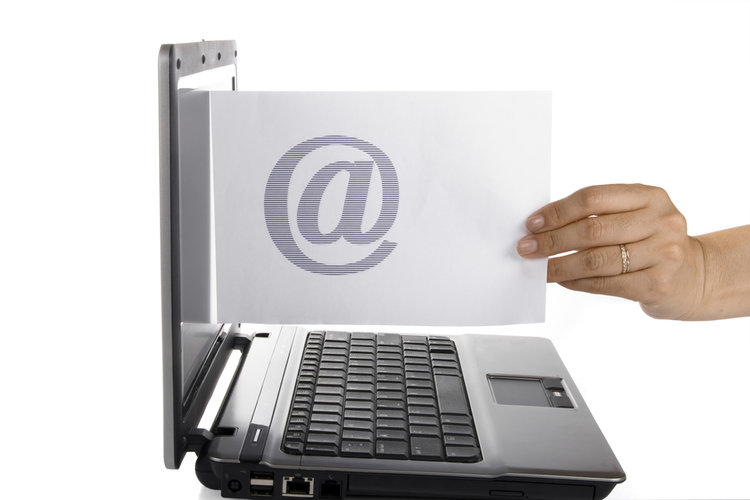
I read recently that someone would never take advice from a financial planner who can’t afford a quality tie (bad taste is a different issue, of course!) My equivalent statement is that I would never hire someone for SEO help/advice or other digital services (social media marketing, web design, ecommerce, etc) if they can’t be bothered setting up a non-hotmail, non-yahoo email address – Gmail and IP provider emails are not really any better.Receiving professional emails on your laptop

The blog I looked at yesterday came to my attention by the owner asking for guest blog posts. He provided a domain name and his Hotmail details. Why on earth doesn’t he have an email based at that domain name? Especially for someone claiming to know about SEO?

This is a pet peeve, but there are some valid reasons to use a domain-related email address:

  • it builds trust to use your domain name – you have taken the time to get a domain name and matching emails so expect to be in business for more than five minutes
  • it looks professional
  • Hotmail does not build credibility – many people use Hotmail as untraceable email addresses so it is not always seen as reputable. Have you noticed a number of places won’t accept a Hotmail address when you register?
  • every time someone receives your email, you can promote Hotmail/Gmail/your ip provider or you can use your domain name and promote your business. No brainer to me
  • it shows you pay attention to the little details in your business so probably care about your products/services
  • it gives consistency, especially when you list your contact details in one place like on a business card or the end of an email
  • you don’t have to change your email address if you change ip providers or the email service stops (or changes rules in a way you don’t like)

You are making an impression…

Sigh. That’s my immediate response to a blog post I just read – sigh.

Doesn’t give a good impression of that blog or writer does it? Every time you write something that goes public, it affects how people view you – yet some people just don’t seem to get that. What’s worse is that this was a guest post on another blog so I assume they didn’t review it before accepting it. Silly as I closed the site after this post, and the rest may be great for all I’ll ever know…

I started reading the post in good faith but the poor expression made me skim the second half rather than read it which is never a good sign. I honestly only kept reading because I hoped the content would improve and justify it’s existence on a site I was reviewing. It didn’t.

Although appearing to be an article giving information, it was a poorly disguised ad for why company X is a good choice for design work – namely because they are young designers. I commented back as I don’t believe all young designers are good, nor all experienced designers lack passion.

Had I been given that article to edit or at least comment on, my suggestions for this article would have been:

  • make sure it all flows and that each sentence make sense
  • give balanced information (eg “while an older designer has experience, remember that new designers are keen to impress and may be passionate about their work” or “new designers have a lot to offer and you may find they charge less to get experience”)
  • introduce any specifics in the article, not just the heading (in this case the heading mentions web design but the article starts with ‘designing is a creative field’ – designing is more than websites)
  • use good grammar and punctuation (“give you the brand image as promised because; they want to earn a good name” does not need any punctuation in the middle and certainly not a semi-colon)

Just as I was leaving the page, I noticed the writer’s bio and sighed again. Nearly every word started with a capital letter (which is so annoying and completely unnecessary) and he claimed to be a ‘professional content writer’. With that example of his writing skills, he is not making a good impression for himself or the web design company paying him to write this article.

How do you respond to such poor examples of work?

Why read a guest blogger?

Many blogs use a guest blogger from time to time, some use guest bloggers all the time; in fact, Matt Coddington suggest that just about every blog will include a guest blogger at some point in its lifetime.

A guest blogger simply means someone else writes a post or series of posts that are published on another blog. For example, I have done some guest blog posts at The Study Gurus. Sometimes it is one or two posts, sometimes there are many posts in quick succession and sometimes a number of guest posts are added over a longer period.

As a reader of a blog, why would you read a guest blogger in a favourite blog? Or would you actively not read it at all?

Spending on your content made easier

Believe it or not, we’re almost half way through 2011 and the Australian (and others) financial year is about to end.

As you may be reviewing budgets now or planning ahead for a great 2012, I am offering everyone who reads my blog a 5% discount for any business writing project booked between now and 30 June (for completion by 1 August 2011).
This could be for a series of blog posts, updating your ‘about us’ page or ghost writing your eBook through to project managing your annual report. Simply email me with details of your project and mention you read this offer on my blog. Or leave a comment and I’ll email you from that.

Consider this my end of year sale and my gift to your business planning for 2012.

A manual by any other name…

It’s an officious sounding word for many people, and certainly a daunting prospect if you have to write or update the manual for your business. So much so, that people often avoid having a procedures or operations manual or just call it something less intimidating.

Which raises the first question – what is a manual?A pile of business manuals

Really it is just a collection of ideas and instructions to help operate something efficiently. It may be boring to read the manual that came with your new iPod, phone or TV but it is very handy when you can’t figure out how to set it up or use the advanced features.

Manuals range from a few pages long to hundreds and even thousands of pages long, depending on the purpose of the manual. Obviously the manual to run a multi-million dollar business will be longer than the manual for your home printer, but the concept is the same.

Here are a few tips to make the concept of a manual less intimidating in your business:

  • call it something other than a manual if the name has negative associations for you – options include guidelines, procedures, rules, ‘helpful information’, policies and the ‘how to book’
  • make sure to write it (or get it written) in simple terms so it’s easy to understand
  • present it in an accessible way – a heavy folder stored on a high shelf will be ignored but a shared computer file on your intranet is much easier to use
  • divide the manual into usable chunks – much better to have a long index than instructions that go for pages and cover many tasks

If you are starting a new manual from scratch, you have the advantage of making it friendly from the start, and preparing procedures and style guides doesn’t have to be frightening either!

Thinking about manuals you’ve had to use in the past, what were some of the big issues with them?