I hope you find my writing and business tips and observations useful. My business and blog are dedicated to helping businesses communicate clearly and reach their potential.
Read, and enjoy!Tash

Learning social media rules
I have been using a lot more social media (specifically twitter) recently as part of my Love Santa project. It because abundantly clear that some people have no idea (or don’t care) about how to effectively use Twitter. 
Top most is having an understanding that twitter is for communicating and building relationships – not for blatant ads like old-fashioned media (e.g. a newspaper ad was a one way message). I saw a few businesses tweet their ad at least every couple of hours with no other messages in between. For one business, they had 3 variants of it and ran them in succession once every hour or so during their business hours. I wasn’t their audience anyway but seeing it so often bored and annoyed me, and gave me an uncomfortable feeling about them as a business.
Next is to have one honest profile. It because obvious when 3 supposedly different twitter users repeatedly sent the same tweet straight after each other – a number of times. It came across as trying to trick and con people, plus it seemed they were desperate for business rather than offering quality or showing a genuine interest in people watching their tweets.
The other behaviour that was annoying while I was on twitter a lot (I haven’t really seen it when just keeping up with people I follow on twitter) was an excessive use of hash tags*.
To me it was like reading a blog post or webpage written to show off keywords rather than actually communicate something – boring, annoying and an insult if they think I am impressed by such actions.
Adding # to key words within a message is fine, adding a keyword or two after the message is also fine, but the following wasn’t so fine:
- adding five or more hashtags after a brief message
- adding hashtags that were about advertising not the message (e.g. adding #santa after a message about a computer breaking down to get noticed for Christmas or adding #webdesign to a message about dreading a visit to the dentist)
- making the entire message hashtags with a link
Tweets are like any other content you write – make it about the message and people reading it, not about SEO and getting noticed by more people, as that is what will genuinely get your message heard and distributed.
I can’t say what results those people get from their tweets, but I know I would never retweet or follow them (and I’m sure I’m not alone). I can say that most of the retweeted Love Santa tweets were those based on replying to someone else – in other words, ‘talking’ to people was appreciated and earned greater exposure to other tweeters.
Twitter can be a great marketing tool but it needs to be thought of as a relationship tool with marketing bonuses to have the best impact on your business.
Or maybe you are happy to read tweets with some of the above characteristics? Or have found them effective for viral marketing?
* A hashtag is simply adding # at the start of a word (or group of words without a space in between) that can be used to highlight a topic and make searching for relevant information on twitter easier.
Content and message must match
Whatever your message is, your content must be consistent as well.
One of my favourite writing tasks is helping Santa write letters each Christmas at Love Santa. They are fun, positive letters and I know that each one will bring smiles and extend the Christmas joy.
Of course, sometimes people feel that they get too old for Santa and question their belief in him and the magic of Christmas.

Writing letters to Santa
Like many others, Love Santa has some information available to help people (parents in particular) to encourage people to keep their belief in Santa. The information is written with care to give tips on encouraging belief but also be read by those in doubt without any additional cause to doubt (and yes, this blog post is also being carefully written!)
Others are not so careful. I just read an article with ‘easy ways to keep your child believing in Santa’ that spends the first few paragraphs destroying any beliefs before giving the five tips. Any doubting child reading it would no longer be influenced by those useful tips so the purpose would be lost – and don’t assume kids don’t read articles aimed for parents!
This makes a clear example of how the presentation of information through choice of words, headings and images can support or contradict the intent and content of the writing. Sure it is harder to write so that the entire message is consistent and acceptable for all potential readers, but it will serve the purpose much better and will be appreciated by those looking for the information.
What examples have you seen of a message not supporting itself? Or maybe you have a Santa story to share (although personal stories are best shared at Love Santa’s blog!)?
Christmas leads in your content
 Using topical links and keywords is good for marketing, but perhaps you can’t see how your business can be related to Christmas or other major events.
I wrote about building trust like Santa earlier in the week as a Christmas-related article. Another example of tying in Christmas is to make a list like Santa to prepare for next year’s tax return (note this example has some good ideas but a lot of the detail are US specific and Christmas is closer to their end of financial year, too).
Here are some more ideas for businesses not obviously connected to Christmas to be able to make use of the season in marketing (other than just putting a picture of Santa or a Christmas tree on a webpage anyway):
 make a naughty or nice list relevant to your field. For instance, a list of reasons to proof read or safety equipment for horse riding are nice lists whilst explaining how to damage your hair or get sun burnt are like Santa’s naughty list
- get into the giving spirit of Christmas – give an amount from each sale to a specified charity throughout December or match client’s donations to a charity
- Santa, his reindeer and boomers all work hard on Christmas Eve so fitness and nutrition people can easily write about how to prepare and maintain their energy
- the reindeer and boomers tie in nicely with animal health and care stories
- anybody selling plants or related services can give alternatives to pine trees for decorating or give tips on caring for a pine tree
- any service provider can of course promote their services as a means of reducing clients’ work load in the busy November/December period
- accountants and bookkeepers can write about the costs of Christmas – tips on avoiding debt, setting budgets, comparing savings systems for next year and so on
- psychologists, counsellors and others can talk about relationships, coping with grief or loneliness at Christmas, dealing with stress, setting appropriate expectations and how to fit everyone’s needs into one day
- anyone dealing with lights (electricians, bike retailers, lighting shops) could probably come up with a message about Rudolph lighting the way for safety
- do some work or sponsoring of a local community group (a neighbourhood house, meals on wheel, elderly club, RSL, etc) to get known locally. You may also be able to use it in a media release, your blog and social media, and possibly in your marketing (e.g. ‘as used by Santa at xyz Christmas party’ or ‘proud sponsor of xyz at Christmas’)
- like some houses have an incredible array of lights and paraphernalia, make your business stand out with a Christmas look – maybe cover your company car with tinsel and reindeer ears and use fake snow on the windows, or make your shop window stand out at night with a beautiful display of lights. Either way will catch direct attention and word of mouth, but again you can add it to a blog, media release, newsletter and a picture on your contact page is a nice touch!
- arrange for Santa to visit and be in your shop or waiting room for set times
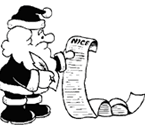
That’s just a few I thought of quickly – what other ideas can you suggest or have done?
Coming up, I will write about general topical connections – it’s too much to do Christmas and general topics on one post!
* Images courtesy of Love SantaUsing Santa for trustworthy content
 Right now, Santa and all things Christmas are popular topics and adding these keywords to your content can be useful.
At any time of year, using topical words and common events in your marketing can be valuable. For example, think about a chocolate company that advertises all year but leading up to mid February, they use more romantic concepts to tie in with Valentines Day.
If you don’t sell gifts, however, you may not think Christmas and Santa can help your marketing.
Actually, you may be surprised at how you can use current events to promote your business (and I’ll give some ideas later in the week) but here is an example from Jeff Bullas where he used Santa in a heading and one tip to tie an article on building trust to the Christmas season.
Let’s face it, are there many people more trusted than Santa? Would people trust your business based on your online presence?
If you do try to link your business in with Christmas, Santa or some other major event, it is important to do it in such a way as to build and maintain trust; make your message relevant to the added keywords rather than just adding topical words in a heading or description for purely keyword and SEO purposes.
* Image courtesy of Love Santa
Cheap writing services
 I was just reviewing the Love Santa blog for my client, including cleaning up the spam folder. In amongst the other spam was one offering a writing service based on one cent per word ($5 for a 500 word article!) from (apparently) US residents.
It annoyed me on a number of levels:
- who would think they will get quality results from a $5 article? Those prices are just cheap and nasty
- implying that because someone lives in the USA they have good English and can write professionally is just ridiculous – what about immigrants for starters? And even those who speak and understand good English may not be any good at writing it
- nobody should be paid such low wages and my conscience wouldn’t let me buy such work. A 500 word article on a topic I know well would take me at least 20 minutes – and I write fast. A topic that requires more thought and some research would obviously take longer. So at best, they are offering $15 an hour and not many would make that much is my belief.
As a business person, I also don’t think much of their marketing. If promoting your services to a blogger, why not offer blog writing instead of article writing? Promoting your service will generally do better if you give some benefit or value to your offering, not just listing a very cheap price.
How about you – would you grab such a cheap offer if it was presented to you as an unrelated comment in your blog?
Aim your content at your target
Whether it’s content for a blog, a newsletter, a website or anything else, it is going to produce the best results if the content and writing suit your potential buyers (your target audience).
Sounds simple, yet it isn’t always done…
Earlier this week I read a post by Paul Hassing which reminded me of when I was selling my house a few years ago. Aiming to sell the house, we tried an agent with an apparently different philosophy to most real estate companies. However, he didn’t like my cute little house (for one thing it didn’t have picture rails like our neighbour’s house did!) and couldn’t sell it. We swapped to a woman at another company who was great and sold it for an extra $20K to the same person the first agent had spoken to.
I think one factor that helped her do a much better job was her enthusiasm for the house – at her first visit she was imagining what people could do in the home and the type of furniture they’d like, and so on. She looked for what was good about the house, thought about the type of people it would appeal to and came up with ideas to feel them on the lifestyle it would give them.
The first agent didn’t like the house himself so couldn’t imagine any extras to sell to potential buyers. Agent two used passion to understand and sell to her audience; agent one saw it as a commodity and tried selling it without emotion, imagination or real interest.
So when writing content remember to pitch the message at the right people and help them picture how the product or service will fit into their lives. Targetting the right people may reach fewer people but it will get more action from those people.
Have you seen real estate agents pitch the wrong house to people, or excite people by pitching the right house to them?
Don’t over generalise
When writing content, generalising can make it simpler to present your message but it can also create issues.
Approximations work most of the time (‘about one thousand’ or ‘approximately half the people’) whereas a generalisation is making a statement about an entire group (such as “all self-employed writers write good web content”). The problem arises if the generalisation is too general to be completely accurate or useful.

Be careful of generalisations – you can look silly if they’re wrong
Some people will read a generalisation without thought, others will focus on the fact there are exceptions to your statement and others will take offence at being included (or excluded). Maybe you don’t care about annoying the pedants of this world, but there may be more of them than you expect in your target audience, and offending people is not often a good plan.
Todays I read a blog post which included the following generalisation:
Whatever size company you are with, you need to establish the roles of Chief Content Officer, Managing Editor, Content Producers, Chief Listening Officer and your Content Creators.
While the blog post as a whole was great, this statement stood out to me because it excludes sole traders. “Whatever size company you are with” pretty clearly indicates that the following information applies to all businesses – but if you’re in a small business, you are not going to have more than five roles within the communications area and may not even have five roles in total! I found this statement frustrating as I can’t assign such roles to different people and this post gave no indication of how to blend the roles if required.
What generalisations have you come across that have stood out for you? Do those experiences come to mind when writing content so you don’t generalise inappropriately?
Breaking it down
Breaking big issues into smaller pieces makes things manageable because:
- it less daunting to look at small tasks than one huge task (remember the elephant – I can eat one bite but putting an entire elephant in my mouth is overwhelming!)
- you then can earn a series of achievements to feel rewarded and satisfied, and see your progress. Working on one huge task means you have to do a lot of work before you can see results
- finishing small tasks can sometimes be fitted into small time slots such as between meetings or while you’re waiting for someone to arrive
- you may be able to get others to do parts of the job. For example, when I manage a client’s annual report I break it into content and design first so I can outsource the design work before breaking the content aspect into sections. I also get my admin support to arrange the printing and to review the designer drafts for any missed corrections.
- you can set deadlines for small tasks and therefore make sure you are on track for the big project – it is hard to know how close you are to finishing and meeting deadlines if the job is just one big task
- you will feel less stressed and overwhelmed, you will feel more in control and capable. Feeling good is a worthy aim in itself, but it also makes you work more efficiently and effectively so you will probably finish the project sooner, too
What projects have you found easier once you’ve broken them into manageable pieces?
Break it down
There is an old saying that I like: How do you eat an elephant? One bite at a time.
Whenever there is a big issue in front of you, your best chance of success (and completion for that matter) is to break it down into manageable pieces and work your way through those pieces.
So I liked another of General Cosgrove’s quotes:
I find complex issues drain energy from people. Many can be overwhelmed. Young people may not know how to attack the beast. Breaking down problems is critical.
Is there a problem you’re facing that you could break into bits? Maybe finding someone to help you break it down would help?
Recent Comments