Welcome!

I hope you find my writing and business tips and observations useful. My business and blog are dedicated to helping businesses communicate clearly and reach their potential. Read, and enjoy!Tash

Refer to older posts…

Blogging services

Ways to simplify your business

Simplicity is great – cutting back on the clutter and staying calm.

Tools to make life simpleIf that sounds good but unobtainable in your business (and life) then keep reading as you might just find something to help.

Last Friday, Susan Oakes posted about simplicity in marketing in which she listed a number of ways to judge if you are overwhelmed and need to simplify a bit. Go ahead and read the list then come back to read my post – it’s ok, I’ll wait for you!

How many things on that list resonated with you? You’re not alone as many of us are overwhelmed, on a short or long term basis.

Simplifying step by step

Like many people, I find that a big list of things to do or pile of papers is overwhelming to the point that you can’t see how to fix it.

The truth is you probably can’t fix it as a whole – but if you attack bits of the pile you will see it disappear. Like I replied to Susan, I found it overwhelming to think of employing someone or outsourcing a lot of things so I just found one thing to outsource (bookkeeping as it happens) and then another and another. Each task clears a little of my load and helps me see past the pile of stuff.

I strongly believe that approaching things step by step is the best option in most cases.

Examples of simplifying

By no means have I fully simplified my life and stopped any sense of overwhelm.

However, I thought I’d share a few ideas that have helped me simplify and gain some time and control back. Hopefully the list will not only help you but inspire you to share more ideas as a comment…

  1.  I use leenk.me (a WordPress plugin) to automate announcements of new blog posts to my social media profiles – it saves me logging into multiple places and matches the announcement timing to any scheduling of posts, too
  2. I use Tweetdeck to organise my Twitter accounts (I manage client accounts as well as my TashWord account so I really don’t want to log into each separately). It also lets me see my Facebook feed but not interact with it (it used to and I miss that ability – I may have to reasearch other platforms like HootSuite now).
  3. storing passwords in Roboform Pro – it is so much easier than remembering not only passwords but which username goes with which account (again, having client and my children’s logins as well as my own, there is a lot to remember!)
  4. using ‘delay send’ in my email program. You’d be amazed at how much I use this 🙂 Examples of when I use it includes saving emails until someone is back from holidays, preparing information when it suits me but sending it at a premium time (or just during business hours!), setting up reminders leading up to a deadline and sending timely messages when I’m away from my desk
  5. Get rid of scraps of paper and put ‘stuff’ into OneNote. This is a recent find for me and I am finding so many uses for it (maybe that’s another blog spot in itself!) but it is handy for key information (like my ABN and email list for cubs) and  jotting down ideas and links to data/inspiration for blog posts and eBooks.
  6. I’ve found Dropbox great for sharing images with designers – it saves me the time of emailing potential images to them as they can just refer to the relevant folder and select what works in that case. It’s also an easier way to transfer large files between us compared to emailing or using a paid for service. (I think dropbox is still invitation only but I’m happy to invite you if you ask nicely 🙂 )

Setting rules for guest posts on your blog

As I have just started using guest bloggers on this blog (see Karol’s post from yesterday as an example), it seemed timely to discuss how you establish guidelines for your guest bloggers.

Why have guest blogger guidelines?

Every blog is different – as are all the bloggers – which means two things.

  1. to keep your blog focussed on your brand and style, you need to define how that happens
  2. not all bloggers will have the same high standards as you  so don’t assume any guest blogger will behave professionally or within your style

Guidelines for guest bloggers helps maintain your blog. Publicly available policies or guidelines will also reduce the number of blog posts you receive that don’t meet your rules.

What goes into guest blogger guidelines?

Well, the short answer is ‘that’s up to you – it’s your blog!’

rules & guidelines for blogs

Fun or formal, long or short, guidelines are handy…

But I’m guessing you want a more detailed answer so here are some important points to consider – you may or may not list all of them for bloggers to see but it’s good to have considered each one relative to your blog.

  1. length of posts – minimums and maximums
  2. unique content vs reused content – including how long after you publish the post can it be used
  3. standard of writing – is average acceptable or do you want great?
  4. standard of content – is it correct and up-to-date? Does it give something new or just spout motherhood statements?
  5. copyright and ownership – be sure the blogger has the right to offer you the post and any accompanying images
  6. how many links can be included in the post? in the bio box?
  7. how long is their bio? will it be shown and can it include images?
  8. do posts have to be informative rather than an ad for someone else?
  9. can affiliate links be included?
  10. what type of content do you want (or not want)? For instance, toplists only takes lists and other sites don’t want reviews
  11. what topics do you want (or not want) covered? Does it have to be something not covered before in your blog?
  12. will links get a dofollow or nofollow attribute?
  13. what promotion do you expect from the guest blogger?
  14. do you expect the guest blogger to visit your site and respond to comments? it’s in their best interests to do so but many don’t
  15. are there suitability factors such as no adult concepts or no swearing?
  16. how often will you post something by the same person?

Which ones do you include in your guest blogger policy (even if it is an unwritten policy so far!)?

Did anything on that list make you say “Oh, that’s a good idea!” and get you thinking?

I’ll post more about hosting guest blog posts soon, but let me know if you have specific questions…

How to get your customers to speak up

Here’s an interesting fact: Customers are much more likely to contact you when they don’t like your product than when they do. “Praise” emails are not that common nowadays.

And this has nothing to do with your product being of not such good quality. It’s just the way humans are set up. When we enjoy something, most of the time we like to enjoy it in silence. But when we don’t enjoy something, we want everyone to know.

So how to encourage your customers to speak up, and not only when they have a problem? Here are 5 tips you can use today.

1. Templates for testimonials

Testimonials are great for generating some proof that your products or services work, and that people enjoy using them.

However, most customers will find it hard to write a testimonial on their own. It always requires a while, and everyone wants their testimonial to sound smart, so they need to find a couple of minutes to craft a proper one.

You can make it a lot easier by creating a template and sending it to your customers. Start by writing your own testimonial, and then remove all the facts from it, leaving just the surrounding words, so everyone can fill it with whatever they want to say.

2. Feedback apps

website feedback icon

Sample icon requesting feedback

These are quite popular these days. Some sites have chosen to display a small icon on the left or right-hand side of their sites (see image – User Voice). The icon usually says something like “Send us your opinion,” or “Suggest a ______,” or whatever else feels suitable for the site.

This is run by an external app so you – the website owner – don’t have to focus on managing all the suggestions, you can simply use the provided interface and be done with it in no time.

3. Feedback section on your forum

If you have a forum that goes along with your site, consider creating a feedback section there.

Create some main threads asking some questions that seem the most important to you. Like for example: “What do you enjoy the most about our products?” Of course, I’m sure you can come up with something more creative.

People are really used to forums online, and they understand the way they work. That’s why your customers are very likely to take part in any discussion you start.

4. Email support reminders

Support via email is one of the most common ways of handling customer support. So here’s an idea. Whenever you solve a support ticket send another email asking your customer about their experience. Make the questions concrete, preferably in a form of a survey, so they can easily (and quickly) respond.

Plus, if you also include an open question, you might just be able to receive some great testimonials that way.

5. Incentives

Here’s the main question: Why would anyone even want to contact you? When customers don’t like something about your product they are contacting you to get the thing fixed. But when it’s already working, then there’s really no reason…

This is why you should consider offering some form of an incentive just for submitting some feedback (not just for positive feedback).

Things that work great are bonuses, discount codes, extra features for no charge, some additional content … it all depends on the kind of product or service you’re offering.

No matter which of these ideas you end up implementing you should remember that customer feedback is essential to every business’s development. How else would you be able to provide your customers with exactly what they want if you never asked?


Guest blogger details: Karol K. is a writer, and online businessman. You can connect with him at ThemeFuse.com where he publishes weekly articles – also a great place to go for top-notch WordPress themes.

Knowing the right terms improves clarity

Reviewing my newsletter from July 2010, I was reminded of the importance of getting your terminology right when writing – thanks to an example of poor writing from someone who considers herself to be a guru.

Clarity vs confusion

As a business, you have a message to get across to people which hopefully will lead to some action which helps your business.

A clear message will be more effective at engaging and inspiring action than a confusing message.

If someone doesn’t understand the message, they will give up and probably think little of your business. If someone misunderstands your message, you will waste time fixing misconceptions and possibly having to pay the price to rectify things.

Knowing the right terminology

Other than through dumb luck, it is next to impossible to give a clear message if you use terms you don’t understand yourself.

Instructions and manuals, vs directories and lists

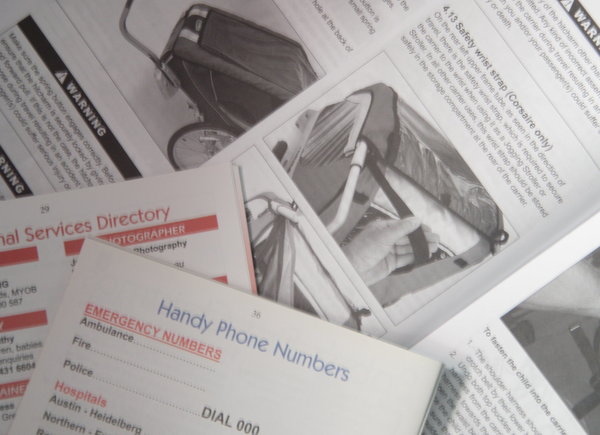
Instructions and manuals, vs directories and lists

The poor example in my newsletter mixed directory and manual. I go to a directory to get details (such as a phone number of address) and a manual for instructions or procedures. The words are not interchangeable.Getting words right is important to communicating your business message. This is the basis of my Monday Meanings – to help people understand words (although it would never occur to me to define manual and directory to avoid them being confused!)

Your reaction

So how do you react when someone confuses a message through poor word usage?

Are you willing to spend time trying to figure out what a confusing message actually means, or do you give up and go elsewhere?

Scroll down and let us know what you think!

Using common ground for communicating

South African & Australian scout badgesLast night we had two South African cubs talk to our Australian cub pack. They showed us their uniforms and gave us an insight into how cubs is different in South Africa.

At first glance, their uniform is very different to ours and not everyone would automatically link them both as cub uniforms, nor recognise all the badges. And it quickly became obvious that the Australian and South African opening ceremonies are different, too.

Yet when we spoke and we asked these cubs questions, our common language made it easy to understand each other and relate the differences.

It was also very nice to invest a new cub, explain that the world scout badge is worn by all scouts around the world and be able to point out that exact badge on two non-Australian uniforms to prove the point and link all the cubs.

Knowing the same foundations

Cubs and scouts are all based on the same principles wherever they are in the world, and each country adds its local flavour.

Yet all cubs know Akela is the leader of the pack, start the night with a Grand Howl and earn both interest and ‘progressive’ badges.

That common foundation made it easy for 8 to 10 year olds to understand each other.

A common understanding also helps business people communicate effectively.

It’s important to use the same language (jargon) when talking to suppliers and clients  – do they know what a bleed or a keyword is? what do they mean by the word ‘benefit’ or ‘pension’? when will they deliver something promised ‘soon’ or ‘fast’?

Building a report, even if it is based on non-business connections, can also help business communications. Have you found it easier to work with someone who follows the same sport as you, grew up in the same area or likes the same music as you? This is one of the purposes of small talk when you start a business meeting or relationship.

Do you note and look for common ground with your business contacts? Do you remember those links so you can revisit them later?

Cub differences

For those who are curious, here are some of the differences between Aussie and South African cubs as discovered last night.

progressive cub badges - Australia & South AfricaSouth African cubs work towards progressive badges (gaining one about every 12 months) called the caracal, cheetah, leopard and lion badges. These badges are round and worn on the front of their shirt.

Australian cubs work for their boomerangs (gaining one about every 12 months) called bronze, silver  and gold. The badges are diamond-shaped and worn on the sleeve – put together with another badge they themselves form a diamond.

The highest South African cub badge is the Leaping Wolf; Australian cubs can earn the Grey Wolf.

South African Scouting consists of cubs (7 – 10), scouts (11 – 17 ) and rovers (18 – 30). Aussie scouts are Joeys (6 – 7), cubs (8 – 11), scouts (11 – 15), venturers (15 – 18) and rovers (18 – 26).

Both countries have interest badges for cubs to earn. South Africans earn red badges and Australians earn a green level 1 or red level 2 badge – all are worn on the sleeve.

Cubs in both countries are divided into sixes, each named by a colour. The cub looking after their six is called a sixer. An Australian sixer wears a badge saying ‘sixer’; a South African sixer has two yellow stripes on his or her pocket.

In Grand Howl, all cubs respond to the call of ‘pack, pack, pack’ and run into a circle. The differences are who calls out ‘cubs do your best’ and how the cubs form their parade circle.

South Africa apparently has 11 official languages, compared to Australia’s one, so that would make for an interesting discussion on communication, too!

Are annual reports just for big business?

What do you think of when you hear about an annual report?

If you’re like most people, you think of thick, boring document produced by big business each year, sent out to shareholders who never read them. And there is a certain amount of truth to that, too.

Annual report rules

If you’re new to business, you may suddenly wonder about annual reports – and if there are any rules meaning you have to produce one, too.

The good news for SMBs is that annual reports are not mandatory for every business. However, once you register as a company you may have to produce annual financial reports (which is usually presented as an annual report).

You may also need to produce some sort of annual report if it is stated in your constitution, deed, financial agreement or other controlling document.

Generally speaking, the rules apply to the financial information you must include; the remaining information is an account of the business for the prior 12 months and is often determined by the company itself or the associated industry standards.

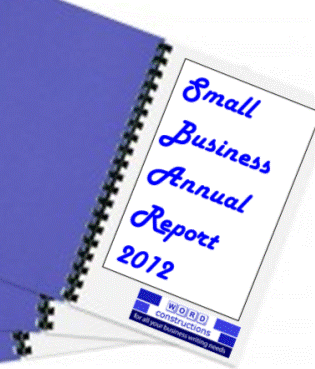
Creating an annual reportAnnual report cover for SMB

So if you don’t have to prepare an annual report, can you?

Yes, any business can prepare an annual report – and add whatever you like to it if you are doing it voluntarily!

A good annual report is a mix of general information, financial information and marketing. It is used by people to decide if they want to invest with the business – whether that means a direct investment as a shareholder or as a client – or even be associated with the business (such as an employee adviser or supplier).

Having an annual report certainly adds an air of professionalism and credibility to any business, and you can limit the financial information if you wanted.

On the other hand, it can be time-consuming and expensive to produce an annual report so it’s not something to be taken lightly.

For a business that doesn’t have to produce an annual report, do you think there is much value in doing so? Would you consider creating one for your business?


Check your edit notes are gone

Have you ever added notes for a designer or typist? Are you sure they were removed later?

It’s an easy and obvious thing to do – add a note directly where it is relevant so someone else can make appropriate adjustments. I do it a lot, especially in pdfs that I send back to a designer for changes.

Make sure they’re removed

Today, I came across this image on Facebook:

edit note remaining ina Cadbury banner
{click on the banner if you want to find out about Cadbury’s competition You may have to log into Facebook though!}

It amused me because someone has asked the designer to add extra information – and the designer has added ‘please add’ as well as the required information. And no one noticed it to have it removed before publishing the banner.

At least it was a polite request that was overlooked!

Being a polite request, this has amused me and in no way detracts from me being a Cadbury customer (given I love their chocolate it would take a lot!) But it does have the potential to damage a reputation.

How do you feel about Cadbury making such an error?

I remember a similar experience in a training manual I once read. In amongst general text was a paragraph to the effect of “Chrissie the following graphic needs to add a break between a and b plus include x, use lower case letters and correct the categories”.

It is funny to tell but it isn’t a professional look for the training organisation!

Testing the reading

Some years ago, I worked in an engineering company and wrote many Expressions of Interest (EoI). I generally took an old EoI and hand edited it, adding and subtracting text as well as moving things around.

The department secretary took my rough notes (and they were rough at times!) and typed up beautiful documents.

Just for fun, I would occasionally test her and write something like “The company has three experienced engineers and the cow jumped over the moon, The little dog laughed to understand this project’s timing.”

It’s just as well I did proof read those documents as the secretary faithfully typed up the cow jumping over the moon!

Can you tell I’m not a talented typist? There’s no way I could type pages of information without actually ‘reading’ and processing it!

Other examples?

Have you spotted live examples of editor comments that have been included rather than followed?

Choosing an annual report cover image

old book covers

We do judge books by their cover…

As important as the content is, the cover of an annual report also needs time and consideration to ensure the report conveys the desired message.

Let’s face it – people see the cover before they read any content so it has the power to set the tone for how people approach reading the report.

A good cover will also attract attention, meet the company brand and complement other company materials.

Choosing an effective cover image and design

Although I let designers be creative with annual report covers, there are factors I consider in preparing a design brief and in choosing the final look.

Some questions I try answering are:

  1. what did last year’s report look like, and how similar should this year’s be?
  2. what central messages have been used during the year? For example, if a theme was used in a lot of marketing I will work that into the cover as well to reflect the year being reported on and maintaining consistency
  3. what are the core elements of the company brand? Can I work them into the cover through design and/or choice of images?
  4. are the images unique to this company? It’s a terrible feeling to prepare a lovely cover just to see the same image on a competitor website a week later…
  5. does the cover look fresh and different? A plain white cover with a logo is simple but can be boring and doesn’t stand out
  6. is the image working with or against the brand? For example, a smiling person can look professional or kitsch so the specific photo is just as important as the concept being used
  7. is there anything in the image that could offend or mislead? Many people have been caught out by some little detail in the background of an image – never assume no one will notice!
  8. could we adjust the image to better suit the brand or cover? Looks at things such as swapping which way people are facing or adjusting colours of people’s clothes
  9. will one image overpower or give the right message? Will multiple images be distracting and busy, or give a broader overview?
  10. if using a tagline on the cover, does it work with the image and design? Change the less important aspect if they aren’t working together

Using images

Being such a prominent position, it is crucial to ensure you have the appropriate rights to use any image on the cover of an annual report. If someone else provides the image for you, check the rights yourself as mistakes will be costly.

If you don’t own the copyright of the image(s), check carefully that usage rules allow you to put the image on the cover and make any changes you want to – don’t assume that royalty free images can all be used in the same way.

Have you ever chosen the image for an annual report cover? How did you choose which one was the best fit?

Ensure your surveys give enough options

Earlier this week, I answered a brief survey from a Government body – correction, I tried to answer a brief survey but the questions stopped me.

For a series of items, you had the choice of yes (I want to get this) or no (I don’t want to get this).  And you had to answer yes at least one to have your survey accepted.

However, for three of the items I already have them. So my answer is neither yes nor no, leaving me in a quandary about finishing their survey.

I choose to answer no because I didn’t want duplicates but I wonder how much that has skewed their results? And how many other people in my position chose no?

When writing surveys and forms

It is really important to think about your questions from every angle to be sure people can complete your survey/form.

Making your questions easy to answer

I think it’s especially worth thinking about if you have made the answers black or white – can you be sure no one will want to answer grey?

exclude people if options are too few

Assuming only two currencies definitely excludes some people

If you’re asking for a gender, under 18/over 18 or in business/not in business, there is a clear either or response. However, as soon as you have a less concrete option, be careful to include that in your possible responses.

While ‘other’ or ‘unknown’ may seem weak answers, they do at least give people the option of completing your questions without getting stuck or making up answers.

And a ‘both’ or ‘all of the above’ answers give a lot more choice, too.


Do you think SMBs need better management?

I think small businesses (overall) are productive and working hard. Do you agree?

Economist with Treasury, David Gruen, is quoted as stating otherwise yesterday – and this has angered a lot of SMBs.

Amongst other things, he said that “family-run businesses tend to exhibit inferior management performance” and that having many small business in manufacturing impacts on Australia’s productivity because multi-nationals “tend to implement strong management practices”.

Business size and management

Note he is actually discussing results of a report showing that Australian managers ranked lower than those in many other nations, especially in people management. And that this same report showed lower managements standards in smaller companies – although only medium and large companies were studied, not small or micro businesses.

I would like a comparison done that includes small and micro businesses as well – maybe we buck the trend and are managed better than medium businesses?

Better management leads to more productivity and innovation, so management is important.

statistics for Australian small business

I like this quote from Gruen:

A  healthy economy allows experimentation by small start-ups with bright ideas, which may tend to have low productivity on average but which are likely to either exit, or improve and grow rapidly over time. It sees labour move over time towards higher productivity firms as they gain market share and away from lower productivity firms.

So Gruen was quoting from a report. If we assume the report was conducted well and reported accurately, there seems to be evidence of better management in bigger companies.

From your own experience, would you agree with that? Does your answer change if you ignore businesses with under 100 employees?

Maybe we can improve SMB management?

Instead of assuming Gruen is anti-SMBs, perhaps we can look at how we manage our SMBs and learn from the multi-nationals.

Take a constructive approach to improve our businesses, even if we don’t think the big guys have it right.

The main areas I can think of for improving SMB management are:

  1. having more written procedures to ensure consistency and efficiency
  2. outsourcing tasks to give back time for better management – or maybe go the whole way and outsource some management as well!
  3. making time to learn more – whether by reading more widely or attending seminars or doing actual courses. And keeping to that committment

In his speech, Gruen gave another partial answer:

 The level of education and skills of both managers and non-managers is positively correlated with management performance.

Unfortunately I can’t find any figures to show how educated SMB and big business managers are. It makes a certain amount of sense that further education increases your skills, but there are of course exceptions of fantastic managers and business owners with very little education.

And it’s a bit hard to make SMBs get more educated when they’re in the middle of running a business or two!

So what is good management?

How can we as SMBs improve our management?

What management practices do big business use that we can learn from?


By the way, you can read the entire speech transcript from David Gruen. I have no personal opinion of him other than this speech but am glad I looked it up rather than just relying on the second-hand report I first read. Anybody can sound bad with words taken out of context.