


Welcome!

I hope you find my writing and business tips and observations useful. My business and blog are dedicated to helping businesses communicate clearly and reach their potential. Read, and enjoy!Tash

Refer to older posts…

Blogging services

28% young drivers killed

In 2007, 28% of Victorian drivers aged 18 – 25 were killed.

two crashed cars and an ambulance in front of a galss of whisky

Alcohol is a factor in the road toll, especially for young drivers

What a terrible statistic.

It’s also pretty surprising – at 30 June 2006, 902,796 Victorians were aged 18 – 24. 28% of that is 252,782.

The Victorian road toll in 2007 was 333.

So I looked at a Victorian Government website and found this sentence:

While 18 to 25 year olds represent around 14% of licenced drivers, they accounted for approximately 28% of all drivers killed on Victoria’s roads.

28% of the state road toll was 93. Awful to lose that many young people, but significantly better than losing 252,782 of them.

Checking meaning is important

That first sentence is perfectly acceptable in terms of grammar and spelling, and it makes sense when you read it.

But the authors and editors of that text book (yes, I found that sentence in my daughter’s current VCE text book on health) didn’t check that the correct meaning was being communicated.

There is a huge difference in meaning between 28% of young drivers were killed and 28% of killed drivers were young.

Somewhat detracts from the credibility of that text book, doesn’t it?

Do you think I should read the entire book and check every fact they state, or assume it was a one-off?


* Image courtesy of kozzi

Reviewing the usefulness of old content links

Old content can still be good or it can be out dated, depending on the topic and the opinions given.

Since May 2012, I have ended each month with a blog post referring back to some of my old content (from my newsletter and blog). I’ll list all seven posts at the end of this one.

It has been interesting to read things I wrote in the past and think about how relevant they are today and how else they can be applied to good business communications.

To be honest, much of my content does still apply as writing doesn’t change rapidly – had I written about mobile phones or social media it probably would have been a different story!

Did it work?

Looking back, reviewing old content each month:

  1. was an easy way to find new content I guess – there was some time involved in deliberately going back to that month of past years and I did have to think of what to write about the old content
  2. created easy posts to write in advance and schedule
  3. helped build more links within my site, especially bringing some of those older pages back to life.
  4. didn’t have any significant effect on the number of readers to those posts (compared to posts made around the same time, there was little variation in reader numbers – with the exception of making procedure manuals accessible which was 3 to 6 times more popular than posts within a week of it going live). Given only one post stood out, I’d say it was more about the topic than the old content link.
  5. also didn’t seem to have attracted particularly more or less discussion either
  6. took advantage of work I did in the past – leveraging is a great concept!

The biggest question to me, however, is what you thought of it.

Was it interesting to revisit old content? Or maybe I was too subtle and you hardly noticed that I was doing it?

Would you like me to continue this into 2013? If so, are there any changes you would like me to make?

My old content driven posts were:

May – planning future communications
June – making procedure manuals accessible
July – knowing the right terms
August – consistency over stats
September – reading efficiently saves money
October – accepting feedback graciously
November – dividing up business tasks
December – honesty in blog comments

Honesty in your blog comments

Once you start blogging you will start getting comments. Unfortunately, a large proportion of them will probably be spam, but the real comments are great.

What about the real but not-so-great comments you may get?

As I wrote a few years ago (back in December 2007 to be precise – old content that still rings true!), I think you have five choices about how to act on negative comments.

Spam and outright abuse I think should be deleted and forgotten.

Comments that just disagree with you or  realistic or even constructive  criticisms are a different story.

Keeping negative comments in your blog seems honest to me – you’re not censoring and are being transparent.

It may be confronting to leave negative comments live, but it gives you a chance to be human and show that you are open to feedback – especially if you show that you have learnt from it.

Have you ever left negative comments in your blog? What response have you got from doing so?

Would you use negative comments to stir a controversy or a discussion?

Wishing you and your family a Merry Christmas

Merry Christmas!

I hope you, your family and friends have a lovely day today (whether you celebrate Christmas or not).

Snack for Snata in front of a Christmas tree and presents

A snack left for Santa last night…

I would also like to wish you a happy and successful 2013.

Please note that I will be working reduced hours from now until the 3rd of January so please be patient if I don’t reply to emails or phone messages instantly!

Do you need to hire an expert?

Recently, I saw an article called ‘do you need to hire a SEO expert’.

My immediate response was yes and no – depending on what you mean by ‘need’, you may or may not need a SEO expert.

Do you need an SEO expert because you have to be qualified or an ‘expert’ to do it (to at least an acceptable level)? No, not really.Professionals see how pieces fit together

However, an expert may do it faster and have knowledge to work more efficiently and get better results, but it is possible to do it yourself. Of course, if you don’t know anything about SEO and have to study it first, an expert’s value is greater.

Do you need an SEO person to help you get SEO done alongside everything else you do? Then quite possibly, yes you do. It depends on how busy you are and how much importance you place on SEO obviously, but SEO is one thing you can consider outsourcing.

Of course, if you are just after time saving, you may be able to use someone to work on your SEO (such as finding places to guest blog or comment and checking your site for deadlinks and duplicate meta data) rather than finding someone qualified to give you advice and expertise.

Does the same apply to hiring a professional writer?

Again, it is a maybe type of answer.

Do you need a professional writer to help you get everything done in a working day? Yes, you quite possibly do need help.

Do you need a professional writer because you can’t do it yourself? That depends on what you’re after. Most people in business can probably write webcopy and blog posts themselves so a writer is perhaps not necessary to get the content onto the page.

However, some people can’t write well so would get much better results via a professional – and probably find it is done with less time and stress, too.

Some people can write reasonably well, but will still benefit from someone who has a better understanding of business writing and can be objective about the content.

So if you can write with good spelling and grammar, understand about writing for a business audience and have plenty of time, no you don’t need a professional writer to help you!

We’re going where?

Doing some marketing research for a client, I came across the following sentence:

With over 37  year’s experience, where sure to make your Christmas party a huge success!

I admit I was stunned to see this error and thus a new Monday Meaning post was inspired.Smartphone map to find Christmas Party location

where: [noun] location or place; [adverb] in what place/position/respect; ]pronoun] which place or point?
I wonder where Simon will be on Christmas Day this year?

we’re [contraction]: we are – we’re is simply an abbreviation of ‘we are’ where the apostrophe replaces the space and letter a.
We’re going to my Father’s house for Christmas lunch this year.

I’m also adding a  word that sounds different but has similar spelling and does sometimes get used in place of where and we’re.

were [verb]: ‘to be’ in the past (ie the past tense) for a plural (we, they) or second person singular (you) noun
We were at my Uncle’s last Christmas Day.

Translation and transcription styles

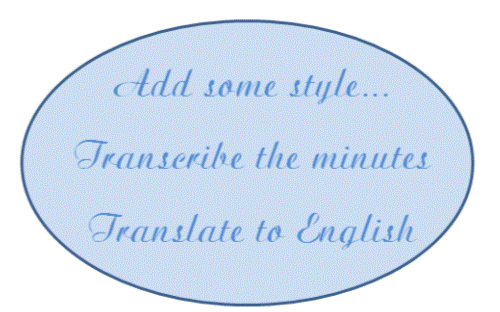
As a writer and communications manager, style guides are important.

It was only when I read a book by a freelance translator and transcriber, Kris Emery, that I thought about style guides for other professionals dealing with words.

Getting written documents

If your business need documents translated or meetings transcribed, you are paying someone to give you a written document that will be used in some way.Transcribe and translate in style

So obviously you want that document to be prepared in a way that is easy for you to use.

That could include details such as :

  • being in your prefered font size so it’s easy for you to read and manage
  • spelling certain words in a particular way – it could be ebook vs eBook or it could be how you want your business or product name represented (think of AvSuper, McDonalds and WordPress for instance)
  • putting meeting records into columns to separate names from conversations
  • location of your logo – you could add it yourself, but why not get the document ready for use?
  • having page numbers or preparation dates in a certain place on each page
  • things to exclude from a transcription (eg remove um, ah and y’know but leave uhuh)
  • page margins or text justification that suits your needs, such as fitting onto a letterhead or space for notes around the text

Preparing a style guide

You have a number of options really…

  1. rely on the person just to translate/transcribe and change the style yourself
  2. assume the person will give you a nice format without guidance and just fix the rest – or get lucky and find someone who will ask the questions to give what you want (and probably write a style guide themselves to use when they next work with you – expect to pay for it if you want access to that style guide yourself)
  3. provide a template and hope the person doesn’t adjust it or any coding behind it
  4. provide a style guide (or at least a style sheet if your requirements are few) for them to work from

A document-specific style guide will by nature be about details, lots of little details that add up to a polished and useful end result.

It can be pulled together in two hours or so if you have an existing document to work from; faster if you have a style template to work from. That’s not much time compared to adjusting a document every time someone translates or transcribes for you.

What are the first three things you would add to your style guide?

Are they things you consider the most important or just the hardest to do so you prefer someone else gets them right?

You’d think the big guys would get it right…

Is it just me, or do you have more tolerance of a small business making mistakes than a big business?

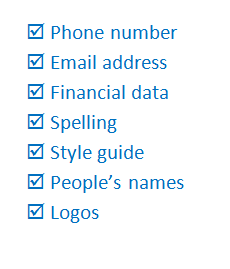
A checklist of items to proofread

A basic proofreading checklist

That is, for mistakes like spelling errors, dead links on their website, out of date information and lack of clarity in a message.

I think if you have the budget for huge campaigns, you have the budget to get a writer or editor to help you avoid stupid mistakes. A sole trader on the other hand often has less money to spend and more hats to wear so mistakes are a little more excusable.

Budget for the details

I was asked by a major entity to complete a survey that they intend to use to produce some data that can impact on the digital media and brands.

It was longer than I expected but more than that, it was very disappointing from a group that is producing such a report.

Having a poor survey through lack of attention to detail reduces their credibility – if they can’t get the questions right, is their analysis going to be any good?

Compared to the time and money they have put into preparing and promoting this survey, and then turning the results into a report, it would have cost little to have had it reviewed by a writer or editor to ensure it would work. It’s like spending a million dollars to build your dream house but not checking the architect remembered to add a front door.

International survey

Some of the issues I came across in this particular survey were:

  1.  I was invited twice (ie via two different .com.au email addresses) to complete this survey. Yet there was a question ‘Please enter your five digit zip code’ – my four digit postcode wasn’t accepted. So are they so ignorant to not realise we don’t all have a US zip code (the error messages actually stated “You must enter a valid US zip code”) or was this survey only meant for US residents?
    Tip: if preparing any sort of online form, make it usable for all aspects of your audience – and make it clear at the start if some groups can’t participate
  2. There were too many assumptions within the questions, but I had to answer them anyway so they are getting meaningless results from the survey. For example, “which of the following do you generate money from?” listed about six possible answers – I don’t earn money from any of them but there  wasn’t a ‘none of the above’ type answer.
    I did get some satisfaction in a couple of those questions if they at least gave an ‘other’ option as I wrote the real answer in that field!
    Tip: always have an answer for everyone in a survey – if people can’t answer, they can skew your results with dummy answers and it frustrates them
  3. One question asked ‘what is your key source for finding companies that don’t meet your requirements?’ followed by a series of criteria that you could use to filter out a company and a couple of other points. In other words, it made absolutely no sense and I couldn’t answer it – well I used the ‘other’ field to say it made no sense so I couldn’t choose from their list!
    Tip: always do a final read of materials to ensure everything makes sense. Edits along the way can change things so read it in full to be sure – and preferably get fresh eyes to view it, too.
Maths error 1 + 1 =3

Poor data can’t result in a good report, whichever way you add it

One better written question they included asked where I got inspiration for my blog posts. I could only select one answer, which is limiting as I find inspiration in many places. However, I again used the ‘other’ option and  wrote I am inspired by poor communications efforts I see – such as surveys like this with poor questions! You have to find fun where you can, I say!

So not a great survey (and I will struggle to trust their results) but it did inspire a blog post and gave me some amusement using their ‘other’ fields!

Dividing up business tasks

Have you ever looked at how you divide up the work in your business?

Last November, I wrote about looking at tasks rather than entire jobs when deciding on who is needed in a team (or who does what in an existing team).

Look at tasks not roles

Tasks interconnect like branches

As a sole trader it can be overwhelming how many things you have to do.

It can also be overwhelming to think about what you could outsource or employ someone for to gain more control.

I know if I look at what I’d like to get someone else to do (and already do so for some tasks), it seems like a mix of tasks that wouldn’t be easy to give to one role. Or would require a lot of training if I did give it to one person.

However, by taking it one task at a time I was able to see what could be done by others.

So I outsourced the data entry of my accounts to a bookkeeper. Later, I also got her to compile some quarterly stats reports for me.

I got someone else to manage sending out email messages – I write the content but someone else gets it into the email system, manages the email list and sends them for me.

Hiring one person or handing out many tasks at once would obviously free up more time instantly (excluding training time anyway). But if it is too hard to set that up, it won’t happen so a series of small improvements was much more effective for me.

Would you find it easier to look at tasks than jobs, too?

Book review: Freelance your heart out

Despite having a pile of business related books to read (or finish reading), and some more business recordings and webinars to hear, I have finished this eBook by Kris Emery.

Why have I read it faster than other books?

I think the fact it is shorter than many business books (being a 141 page eBook) makes it easier to get through it, but that’s not enough by itself. Freelance your heart out is a friendly, chatty style that is easy to move from page to page so it is achievable relatively quickly.

What is it about?

eBook cover for Freelance your Heart Out

eBook cover

Kris works as a freelance transcriber and translator, and this eBook is basically her journey from corporate employee to successful freelancer. From her journey, Kris has picked up a few things and she shares them in this eBook so others can enjoy a freelance lifestyle if they wish.

While some parts are specific to transcribing and translating, most of the eBook is easily relatable for other freelance skills – as a freelance writer, I know I was either nodding along or finding a connection throughout her tips.

There are 25 specific tips in the book, each of which offers value to someone thinking of or starting as a freelancer. Read as part of the entire eBook, these tips are even more valuable as they come after a story or example that illustrates the tip.

Reading Freelance your heart out

As I’ve said before, hearing someone else’s business story is not my prefered way of learning something about business. However, Kris actually states the lessons, not just her story, so it becomes more useful than just her freelance story.

The writing style is easy to read, but does have some substance to it, and reading the eBook inspired some ideas and thoughts – and a few blog posts as well! A few spots I found hard to read, and needed to be reread more than once, which was a shame.

I like how Kris has included some practical information as well as more general tips (like learn to negotiate and set greater goals).

It is not, however, a complete guide to starting a freelance business, but gives some good ideas on what is needed and hope that it is possible for many people.

I also like the fact that she doesn’t make freelancing seem like easy street or something to do in your spare time to make a fortune – being a freelance anything takes time and dedication to make it work. It can br a great lifestyle (for example, I love being able to take my son to kinder and help at school as required) but it usually is much harder than having a traditional job.

Whether you end up working freelance or changing corporate jobs instead, having a realistic idea of freelancing could help you make a wiser decision about your future.

If you have ever tried freelance work, did you find it tough? Did you expect it to be easier than the reality turned out to be?