
TashWord
Tash is a professional writer who loves helping people communicate clearly and effectively.


Ideas & plants take time to grow
Last night I read a blog post on guest blogging (or SEO outreach) as it is something I am interested in and enjoy doing. There were some great tips in this blog post, but there were also a couple of points that I reacted to.
Researching blogs to offer posts to is obviously an important step in guest blogging, but I disagree with the following statement:
If you don’t have any ideas for articles the first couple of minutes of scanning the website, better spend the next minutes looking for another website to scope out.
Many people will never find a host blog if they used that criteria!
A couple of minutes may show the blog is not suitable for you (eg the wrong topic or demographic) but it often isn’t enough to get ideas. Sometimes I get ideas from the first sentence I read in another blog, but other times I have to read a few posts to get a feel for that blog and allow inspiration to strike.
Creativity is in all of us, and I believe it can be developed, but even so that’s a lot of pressure to state you need to find ideas so quickly while also assessing the blog overall.
There’s a business concept about giving clients a choice of two elements – well done, fast or cheap. They can’t have all three options in the same project.
I think that’s true for guest blogging, too. You can do it well – quality writing on well researched blogs to build relationships with bloggers and their audiences – or you can work at getting a lot of posts online in a short time frame.
It’s that old quality vs quantity argument, I guess.
And to be frank, if you give me the impression of trying for maximum posts rather than quality the chances are I won’t accept your guest post. So I would never tell people to only spend a few minutes researching a potential host blog – it looks fast rather than in-depth to me.
How do you develop ideas, whether for a blog post or anything else?
Do you give up if no idea hits within a couple of minutes?
* Images courtesy of 123RFI’m busy, you’re busy and I suspect even people (including Government employees) writing surveys are busy.
So why do people put up silly surveys and waste everyone’s time?

Throwing time away…
Late last week I was asked to fill in a Government-run survey gathering information to help small businesses – a worthy cause so I completed the survey.
But some of the questions were a waste of time – not only were they hard to answer, I doubt they will give meaningful results so it has wasted everyone’s time.
Here are some of the worst questions I answered, with my comments to explain why I didn’t like these particular questions.
Q1 – is your website interactive? Can you edit it yourself (eg online forms, content)?
A1 – yes or no
What is the correct answer if my site is interactive but I can’t edit it, or if I can edit it but it isn’t interactive?
Q2 do you use a still or video camera for work purposes?
A2 – Yes – what do you use it for?
Um, for taking photos or videos? I wonder how many people gave that answer! I decided to be nice to them and answered ‘take photos for use in my blog’. Or did they want to know if I use photos of videos?
Q3. who is your local IT service company in a, b and c?
Personally I had no idea! And what did they mean by local anyway – same suburb, same city, same state?
The question perhaps makes more sense if you assume they want to know who I used for those services or maybe they were trying to ask ‘do you use a local IT service company for a, b or c’.
Q4. how do you get business advice and information?
A4 – rate each option in the following list {which includes trade magazines, state gov department website, dept of broadband, communication & digital economy}
The list did not include professional advice (accountant, coach, etc), online articles/blogs or government business info sites which were the first three things I thought of! Yet it included such specific things as a government department site and the dept of broadband, etc which I have never heard of!
When giving answers, it is important to review the list to ensure it covers enough breadth – or change the question to indicate it is a narrow aspect being researched.
Q5. do you or any of your staff telework? (work from home connecting remotely to the business network and database.)
How do I answer that – I work from a home office so I am nearly always connecting to the business from home but I don’t think it is really telework when the network is also at home!
Do they want me to include sub-contractors/suppliers as staff or keep ‘staff’ to mean employees?
Maybe this post will compensate for the wasted time as at least we can all learn what not to do in our next survey or feedback form!
My strong recommendation is to always get an outside person to read a survey when you think it is finished because they will spot errors in logic, assumptions and inconsistencies better than you can.
What are your survey stories? Have you found they are harder to write than they appear? Or maybe you’ve come across some time-wasting questions like these ones. I’d love to hear them – although it would be nice to think most surveys are well done!
Setting up a blog may seem daunting but it really doesn’t have to be. However, the first step, how to host your blog, can be difficult if you haven’t done it before.
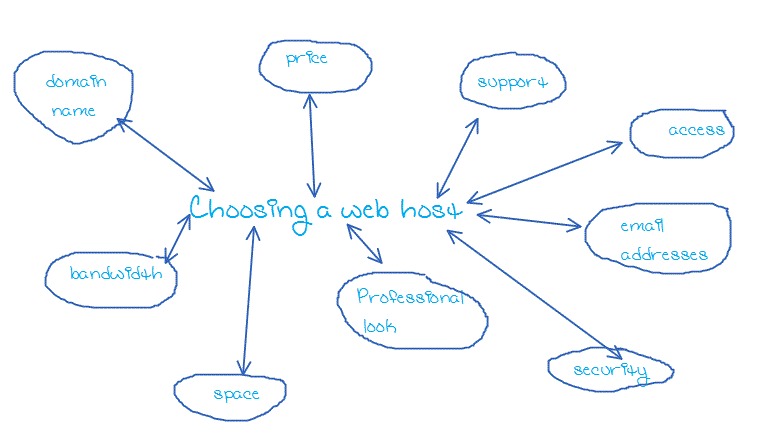
Some things to consider
So, here are some things to know and consider before making your choice…
What other questions are you considering (or did you consider) as part of your decision?

The right website elements = sales & money
If you run a business website, it makes sense to have it help you sell stuff, right?
But have you ever looked at your website to see if does help you sell stuff, or if it makes hard work for your potential customers?
I have been looking for some software for a c lient without any prior knowledge of any relevant suppliers. So I was relying entirely on what I found online.
Not surprisingly, I looked at a few sites.
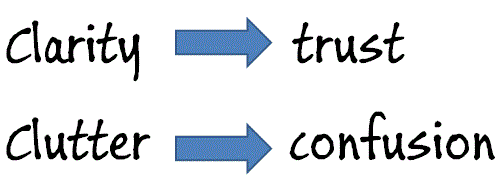
I actually looked at a couple more potential suppliers, but these four showed the absolute importance of a good website to help you sell to prospective customers.
*Images courtesy of 123rf
Simple and simplistic are not the same…
While being closely related with the same root word, today’s pair of words are quite different – and understanding them can be quite enlightening.
simple [adjective]: basic; missing elaboration, ostentation, complication and subdivisions
Basic arithmetic is simple to write and calculate; quadratic equations are not so simple!
Following main roads is simpler than maneuvering through side streets.
In grammatical terms, simple means having only one clause without any subordinate clauses or modifiers.
simplistic [adjective]: over simplified, missing information or depth
Saying income is the indicator of career success is simplistic.

Love & money can go together
I know – Christmas has just gone, Australia Day hasn’t even arrived yet and I’m suggesting you think about Valentines Day!
For many businesses, Valentines Day is a huge sales period and they probably plan and prepare for it months in advance.
But have you thought about it for your business?
Maybe you think it is only for those selling flowers, chocolates and cards, having no relevance to other businesses. While there is some truth to that, you can get more out of Valentines Day if you want to.
Yes, Valentines Day is commercial and it would be great if we showed our love and care for others every day, but it is celebrated every February whether you like it or not. And if you run a business, you can keep it topical through using some Valentines romance.
There are a number of suggestions in my Valentines Day and business article, but here are a few more:

Paper flowers last longer and, if hand made, are very personal

Four ways to write the same thing – look for simplicity
I often come across things that are too complicated – usually it’s because people are trying hard to give all information, but that doesn’t change the impact on your audience.
If it is too hard to understand the message people get bored or impatient and go elsewhere; at best, they will contact you with unnecessary questions because that’s easier than searching the website or document for answers.
‘there are limits to how much super you can contribute each year’ (my version)
is easier to read than ‘legislation states people making superannuation contributions above certain prescribed maximums that vary between the types of contributions will be penalised’ (a complex version I read).
‘In Australia, you can see an optometrist without a referral. However, you will need a referral to see an ophthalmologist.‘ (my version)
is simpler than ‘No referral is necessary in Australia to see an optometrist or if needed with an ophthalmologist (you’ll need a referral from an optometrist or from your doctor for this)’. (from a complex article written for lay people)
‘ABC provides telephone support to customers at our discretion’ (my version)
is simpler than ‘ABC will provide Telephone Support at its sole option and for as long and for such hours as it may decide Telephone Support for the Customer.’ (from a contact us page, and let’s ignore that it doesn’t even make sense and doesn’t need all those capital letters!)
* Chemical structure courtesy of BigStockPhotos
It is February and we’re almost at Valentines Day. 
Personally, I don’t care about the commercialism of the day. I consider it a reminder to acknowledge those people we care about, both romantically and otherwise, in a way we probably don’t think of throughout the year.
I aim to send a note, letter or email to people close to me for Valentines Day, just so they know I care all year, even when I forget to tell them.
For those romantically inclined, I wrote an article on writing love letters, and another on how to present love letters in a special way. I also wrote a number of Valentines articles for Save Time Online, including Valentines ideas for singles!
And for those interested, Valentines Day, Valentine’s Day and Valentines’ Day are all grammatically correct! It depends which grammar rule you believe is more important as to how you write the word!
Valentines Day – the name of an event, such as Good Friday or Christmas Day
Valentine’s Day – the day owned by or relating to Valentine
Valentines’ Day – the day owned and celebrated by valentines (lovers) everywhere
The same answer applies to Mothers and Fathers Day, too.
So what is your preference for writing Valentines Day? Is that just what feels right or have you thought about what is ‘correct’?

A funky gift is nice without sending inappropriate romantic messages!
I wrote about an officious bank letter that resulted in me closing my account.
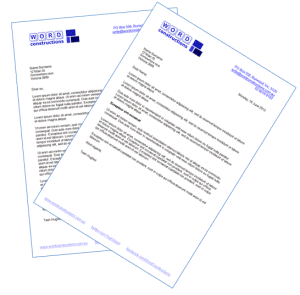
Professional looking letters are part of your brand
There was more to that letter for teaching about good letter construction, so here are some tips for you…
Some years ago, I opened a saving account with a higher interest rate for the proverbial rainy day. I haven’t used that account much for some time but received a letter from that bank that I wanted to share.

Threatening people’s savings doesn’t create a good impression
With opening words ‘Inactive account’, the letter launched with a long paragraph about money in inactive accounts being transferred to ASIC. The paragraph ended with a ‘by the way, the Government recently changed the inactivity period to 3 years from 7 years’ message.
It went on to define in active accounts.
Followed by a sub-heading “Your inactive xyz account”.
At this point I was angry because I hadn’t been told about the change in law nor that my money would be transferred to ASIC so “how dare they do that”.
The letter then mentioned I could prevent the transfer by using my account before the end of January.
Why not tell me that first as it is actually the most important thing for me to know?
And encouraging me to make another deposit is surely in the bank’s best interests, too?
Why let me get angry and annoyed rather than show me they are trying to help my keep my money?
The harsh letter made me uncomfortable, and as I only had a small amount of money left in there, my response was to withdraw all my money and close the account myself.
This is obviously a necessary letter for banks, but I think they are missing a relationship building and marketing opportunity to write it in such harsh terms.
Even if most people still closed their accounts, they would do so without negative feelings towards that bank…

Being friendly builds goodwill and reduces stress
In contrast I recently wrote a letter for a client along similar lines.
That letter effectively read:
You haven’t made a contribution for some time so your account is about to be classed as inactive.
If you make a contribution by xx, your account will be reactivated. Otherwise, your account will have to be closed.
Another option would have been to write:
Did you know that any account without transactions for 3 years are classed as inactive? And that we have to transfer money in inactive accounts to ASIC?
To avoid this for your account, please make a deposit or withdrawal by xx.
Or they could have focussed on the change in law as important news:
Did you know it’s been nearly three years since you used your account?
The Commonwealth Government recently changes the law so accounts are classed as inactive after 3 years rather than seven. That means your account could soon be classed as inactive.
By law, we must transfer money from inactive accounts to ASIC.
Of course, you can reactivate your account by making a deposit or withdrawal before xxx.
Which version would you prefer to receive?
* Images courtesy of kozzi
Recent Comments