
I came across this great infographic outlining why children need to be able to read.
As well as being a good message in itself, the infographic also supports Buk Bilong Piknini (a charitable organisation funding books and reading programs for children in Papua New Guinea).
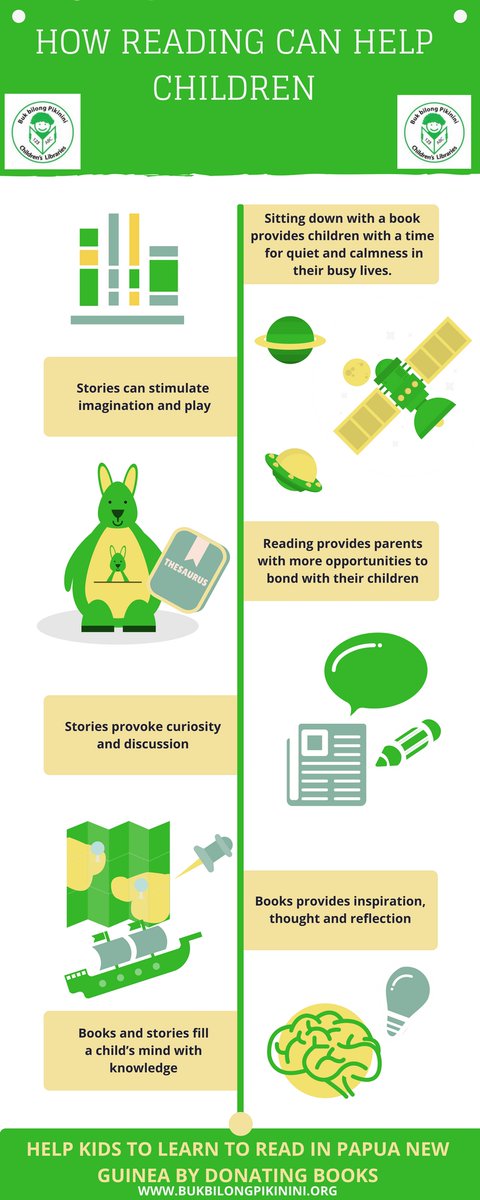
What do you think – why is it important we encourage children to learn to read, and then read some more?
I would also encourage everyone to help ensure our children are literate – whether by donating to groups such as Buk Bilong Pikinini, helping at schools or giving books as gifts, every bit helps.
Helping children learn to read
I frequently help at my children’s school by listening to children (usually not my own!) read and helping them build the skills of sounding out new words, ensuring the words make sense and getting a full understanding of what they are reading.
Why do I (and many others) help these children?
- learning to read opens many opportunities for children – through learning, ideas and comprehension
- the sooner they learn to read, the easier other aspects of school become – delayed reading can limit other learning and become a downward spiral for education
- I love reading – books give me pleasure, ideas, an escape and relaxation – and I hope to share that pleasure with children
- all the children benefit by their classmates being able to read – teachers can concentrate on contact rather than reading if all students can read competently (for their age) and each child can contribute more ideas and experiences if they are well read
- seeing me place an importance of everyone being able to read, encourages all the children to value reading
- seeing people volunteer to help at school also teaches children about community spirit, generosity and being able to make positive change in small ways
What have you done to help children (or adults for that matter) learn to read and enjoy reading?



Natural learning is a good approach for children to learn the basics and train them properly while they are young.
Absolutely natural learning is wonderful for children, and I love grabbing opportunities for kids to learn (often without them having the slightest idea they are learning!) Kids develop some reading skills through natural activities such as being read to, seeing their name, puzzles and blocks with letters on them, and seeing others reading for pleasure.
Children learning to read are entering a new phase of life and hence need more support and care.
Well. starting to read is a new phase for children and it opens up so much for them. But learning to read is a long process so I don’t think we can consider it a new phase through all their learning to read!
I think we need to support them as it is so important for them to be able to read – it gives them independence, access to information, access to enjoyment (books, magazines, etc) and more employment options later on – plus we want it to be enjoyable and not overwhelming or they will lose interest and miss out on so many things.
It was a great post about raising children. I was really impressed by how you explained it. As a child I always wanted to have a good time with my parents. So I know how my kids feel. I will do my best for you to have good memories with me.
Teaching kids to read isn’t easy educators often feel strongly about what they think is the right way to teach this essential skill.
Absolutely Junnun – teaching children to read is something teachers are trained to do, and its a big task.
Informally, we can support that learning though – reading to children and letting them develop a love of books and words is the best aid we can provide.
As a parent, I’ve always had concerns about whether I’m doing a good job teaching my child essential skills.
Recently, I stumbled upon a valuable resource online that caught my attention.
I came across a video where a dad shared his experience of teaching his little girl to read before she turned 3 years old.
It amazed me because, in today’s world filled with misleading information created solely for popularity, finding genuine and helpful content is a rarity.
So I decided to give it a try. Following the methods outlined in the video, I adapted them to suit our daily routine.
To my surprise, my daughter made remarkable progress in just 2-3 months.
Witnessing her joy and pride in her newfound reading abilities reassured me that I was on the right track as a parent.
I’m grateful that amidst all the noise online, there are still people sharing valuable resources that truly make a difference.
If you ever find yourself questioning your approach to teaching your child, I encourage you to explore the possibilities.
Beautiful, practical post, thanks for highlighting why reading matters and the Buk Bilong Pikinini link. Volunteering at schools, listening to kids read, and gifting books are simple ways to widen opportunity, boost classmates’ learning, and model community generosity. Early reading prevents downstream learning struggles and builds lifelong curiosity; this inspired me to donate and volunteer locally, eagerly starting this month.