I hope you find my writing and business tips and observations useful. My business and blog are dedicated to helping businesses communicate clearly and reach their potential.
Read, and enjoy!Tash
Despite the similarity in spelling for today’s words, they have very different meanings.
contemn: [verb] scorn, disregard, feel contempt for He seems to take price in his ability to contemn new performers.
contemplate: [verb] consider, envisage and observe consistently about a likely or probably action or outcome A wise person will contemplate all options before making an important decision.
The word contemn is not used a lot, but some people question whether it was the intended word in line two of The Ode (part of For The Fallen by Laurence Binyon and used in ANZAC and other remembrance services around the world):
They shall grow not old, as we that are left grow old; Age shall not weary them, nor the years condemn. At the going down of the sun and in the morning We will remember them.
help you make decisions
For example, if your policy is to be wholly Australian, it is easy to decide against international advertisers
save people asking you questions
Policies stating you don’t have advertising or guest blog posts mean fewer people will ask if you will accept their ad or post
reduce arguments
A no profanity policy is all you need to point out after editing the swearing out of someone’s comment or guest blog post
give comfort to someone looking for information about your and your business
For instance, if you offer lessons to children, I will trust you more to see your blog is family friendly and moderated
add to your professionalism
A policy shows you have thought about your blog and what it represents.
Have you made decisions about any blogs based on their policies?
How do you like to be updated about new blog posts from your favourite posts?
You can just visit the blog regularly in the hope of finding new posts and not missing anything good, or you can make use of technology to let you know about new posts:
RSS feed will collate all new posts from your listed blogs in one place
tweets from the blogger
an email sent from the blog
Facebook, Google + or linkedIn status updates
links in the blogger’s newsletters
updates from places like Google Alerts and Wotnews
Does your preference change for different types of blogs or different frequency of posts?
Theory has its place, but an example often makes learning something much easier. In many areas, an example of a mistake or poor quality is an even more effective teacher than examples of the correct technique.
Or I can give an example: Leave as long as possible before proof reading your writing.
Or I can show you a bad example: Another effective way to increase the possibility of increasing your link building purposes… Then explain the issues with it and write it well: Another effective way of potentially increasing your incoming links…
Does it work for you?
Do you like seeing poor examples of something as a means of learning to avoid those same mistakes yourself?
The bad examples I use are real but I never identify who wrote them – if you searched hard enough you might figure it out, but I respect that the writers didn’t mean to provide us with bad examples and use discretion 🙂
I think it is an effective way of showing how to write well – but do you find it useful? Would you like to see more bad examples I spot to help you improve your writing?
Unfortunately, I came across the following sentence online last week:
It is true that having an online presents is very important, however it is just as important to have a real life presents.
So today’s Monday Meaning is aimed at correcting that sentence, and preventing it ever being written again!
presents [noun]: something given to another; a gift The pile of presents reached the branches of the Christmas tree.
presents [verb]: the act of handing over and introducing something or someone The compere presents each nominee before the awards are announced.
presence [noun]: the existence or occurrence of someone or something in a particular place The contract must be signed in the presence of two adult witnesses.
To remember which is which, think about the presents you have been sent.
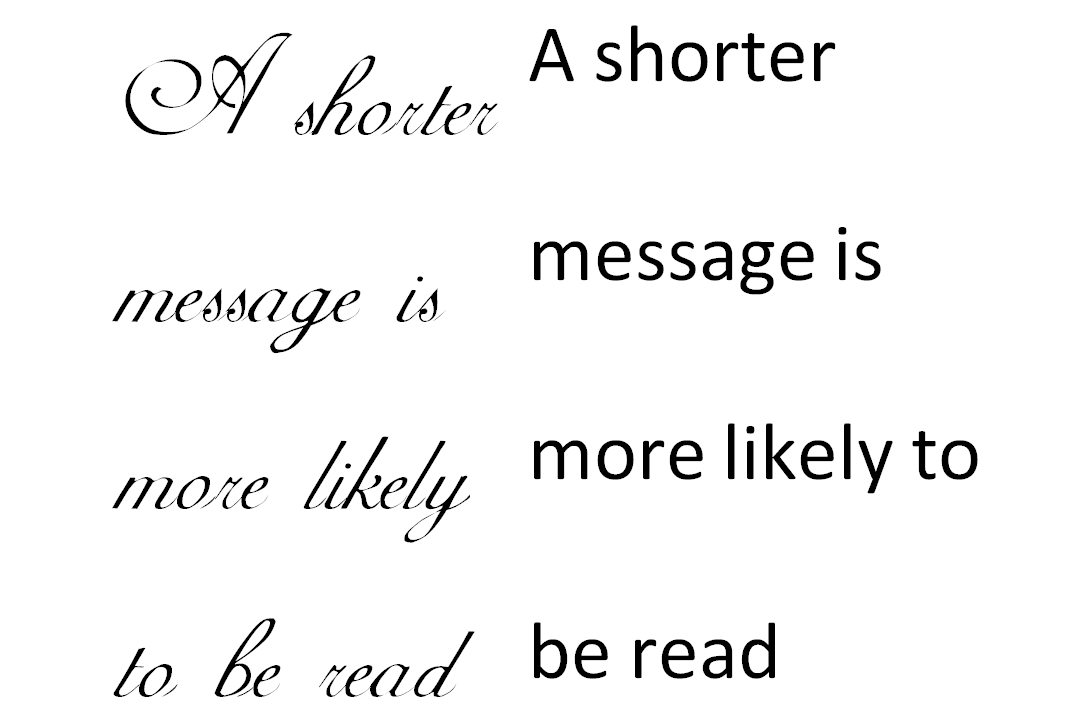
Research has shown that ornate fonts make a task appear to be more time-consuming than the same task written in a clearer, simpler font. An ornate font could actually make your products and services seem slow or tedious, which is obviously not an image you want to promote.
Dooley stated that a simpler font will communicate your message better because it is easier to read and looks easier to read (i.e. is more appealing). Just like a simpler message is easier and more appealing.
What do you think – does a fancy font impact on how you perceive a product or service?
Which font is clearer?
PS The recommendation is to use a clear font such as Arial for descriptions and instructions.
Singing is just saying words in time to music, really. I even get requests to sing most days – Twinkle Twinkle and once I caught a fish alive are some of the most frequent requests. So it’s probably time I recorded my first album and gave Lady Gaga a run for her money isn’t it?
I know how to run, too – it’s like walking only you pump your arms and go faster. So I think I will join the Australian Olympic team, but can’t be bothered training much before London.
Do those ideas sound a little silly?
Assessing your own skill sets
Obviously there are many things I can do (cook, draw, throw a ball, hammer a nail, first aid and dance just to name a few) but most of those things I can’t do well enough to call myself an expert or expect money or fame for.
So why do so many people think that because they know how to form letters with a pen or type, they know how to write to a commercial standard?
Acknowledging that writing is a skill
I have come across a lot of examples lately where people think they will start an online writing career for easy cash or because they like the freestyle lifestyle. And others who ‘offer writing expertise’ while demonstrating they can’t spell or write a coherent sentence.
It frustrates me – not because I feel they are any threat to me (my clients want quality and can tell the difference between poor and good writing) but because it cheapens the efforts of quality, skilled writers (like Paul Hassing, Sarah Mitchell, Lorraine Thompson, Desolie Page and Belinda Weaver to name a small sample).
It angers me when these same people put information out there that is wrong or easily misunderstood. If their readers don’t know any better, they could be lead into costly mistakes. Good writers not only write well but, for less known topics, research the material or get expert assistance on the content before posting any content online.
Writing well is a skill – aspects of it can be learnt (such as how to spell correctly and when to use a capital letter) but much of it comes naturally and through experience. Reading and learning contribute to the skills of a writer, so even great writers can improve.
I can write well. I can sing – but only well enough to entertain my toddlers and enjoy myself (Lady Gaga need not fear me as competition!) I know the difference between those skill sets and use them accordingly. Is it so much to ask that other people realistically assess their skills, too?
I have just read a memo from a client’s supplier about an update to their corporate style guide.
The article explains the value of the style guide, with comments such as “maintaining a consistent look and feel to all materials was crucial in maintaining a positive and lasting impression of the organisation.”
Comprehensive style guide
Putting the elements together for a brand
As is often the case, the article discusses the design elements of the brand (such as where the logo goes on letterheads, forms and advertising). Designers often prepare (or advice on) a style guide that is actually a design style guide; a comprehensive corporate style guide will include all elements of the brand style such as spelling and punctuation conventions and writing style.
For true consistency, a style guide must include everything. It can then be split into components for specific uses – such as pulling out the website design section for a web designer or the logo and colours for a form designer.
Logo guidelines
In case you are working on your style guide, here are some of the key points this article mention about use of their logo to get you thinking more broadly.
only use the logo in provided formats and colours
use the logo only once in corporate documents
use the entire logo (i.e. don’t split the image from the text)
never print other images or word over the logo
logo must be prominent
unless using a provided template, get approval from {name} before using logo in external materials
Have you considered all those issues for your logo and included them in a style guide?
Sometimes you will receive guest blog posts that are pretty good but not quite at the standard you want for your blog.
I know I have read blog posts that have great ideas and tips but are poorly written or posts that seem good but don’t quite develop the ideas enough to be useful.
The temptation is therefore to edit the posts so they also read well or make their intended point.
Is it ok to edit guest posts?
Yes and no!
If the guest blogger has made a simple error or two (for example you instead of your, busniess instead of business, or copywrite instead of copyright), then I would fix it for them.
A good writer would prefer you to fix that (or ask them to) then let them have public errors. And may not realise you have made the changes if they don’t go back to their original.
However, it is still polite to let them know you edited their work.
On the other hand, if the post has numerous and/or more serious issues, it is not ok to edit it without the author’s consent.
Remember that the guest blogger’s name will be with that piece so they have the right to know it is in their words – and you also enter into legal issues for what is called moral rights.
I think there are three ways you can get an edited post:
Return it to the author with an explanation of what is wrong and ask if they are happy for you to edit it – offering to get their approval before publishing of course
Edit it and return it to the author for approval before publishing it – make sure you introduce the subject nicely as some people will be offended at you doing this
Ask them to edit it (and ideally explain why it needs editing so they have an idea of what to change)
Some blogs have a policy stating that they can edit the post before it goes live. Even with such a policy, I would not advise doing heavy edits to someone’s work without giving them the power to accept/reject those changes.
If you submit a guest post, how would you like the host blogger to deal with your work if it contained errors?
So how does linking to other blogs help your blog?
you provide additional information for your readers which they will appreciate – especially if you link to someone who gives a different perspective or technical input to your blog
you can support your opinions and knowledge with other posts to build your credibility
search engines give you credit for outgoing links when assessing your blog’s ranking so linking to others, especially other good blogs and posts, is good for your SEO
the people you link to will probably appreciate your links. Many of them will leave a comment in your blog or return the favour by linking to your blog
others’ blog posts can inspire ideas for your own post so why not link back to the post that inspired you? Either as a courtesy or as a means of introducing the issue you are posting about (i.e. it saves you writing out a detailed background for your post)
your blog is more interesting if it has variety and links off to relevant materials, whether on your site or elsewhere – and people are more likely to share interesting posts and blogs than boring ones!
So when is the last time you linked to another blog within one of your blog posts?


 You can just visit the blog regularly in the hope of finding new posts and not missing anything good, or you can make use of technology to let you know about new posts:





Recent Comments