





Welcome!

I hope you find my writing and business tips and observations useful. My business and blog are dedicated to helping businesses communicate clearly and reach their potential. Read, and enjoy!Tash

Refer to older posts…

Blogging services

Why reject people, not ignore them

Email message of no thanksSometimes in business you need to not accept someone. You can choose to actually reject them or you can just ignore them until they effectively go away.

Whether it’s someone who has applied for a job, sent you a guest blog post or given you a proposal, that person has put some time and energy into contacting you. And quite possibly has some emotional involvement, too.

Of course, I am not counting the obvious spam offers you get – spam doesn’t deserve much in the way of respect and certainly shouldn’t get a response (as tempting as it is often may be!)

Choosing your response

I think those people deserve the respect of being answered. No one likes to hear ‘no thanks’ but it’s better than hearing nothing and waiting for a response.

Do you remember applying for jobs and not getting a response? I hated putting in all that effort and then not being sure they had actually read my application if it wasn’t acknowledged.

Saying no can be done quickly and harshly without any thought for the other person’s feelings. Or with a little more effort you can be respectful and assertive, leaving the other person with their self-respect. Either way, it doesn’t really take that much to give an answer.

You can even have a stock rejection response on file to save time, if you must.

I prefered getting a standard letter than nothing back when I applied for jobs.

Rejecting does have a payoff

Aside from being the humane and decent thing to do, actually rejecting someone’s approach can benefit you as well.

For one thing, you aren’t damaging your own reputation. Offend enough people, or convince enough people are you too lazy to reply, and you may just find fewer people respect you and want to offer you guest posts or their time and expertise.

Sending a nice rejection maintains relationships. Just because you don’t want to use this guest post or don’t think Mary suits your current job position doesn’t mean those people can’t offer you something of value later on. Burning bridges by ignoring people just doesn’t seem like a wise move to me.

What other reasons are there for taking the time to say ‘no thanks’ to people?

Have you had good things come out of a ‘no thanks’ response?

Choosing a side of the story

Every story has (at least) two sides. As a writer, you can choose which side you are going to tell, or focus on – and that choice can have consequences.

A business can focus on the message ‘our product has these great features’ and sell a few products.

Or that business could focus on ‘our product can help you these ways’ and make more sales.

You can choose what to communicate, even on a simple topic

Yesterday, tens of thousands of people gathered together in Melbourne in memory of Jill Meagher, and for a better world.

For over a week, many people have discussed Jill’s disappearance and the discovery of her body – in blogs, tweets, Facebook updates, and more, as well as in mainstream media.

People are upset at what’s happened. What happened was awful and the person responsible must be stopped. Jill and her family deserve that, and respect and sympathy. As do all the other people, and their families, who have been raped and murdered.

I read a related tweet yesterday which clearly showed two sides to the story around Jill Meagher. Notunimportant tweeted “So frustrated by talk of protecting women instead of ending violence.”

Protect or prevent?stop violence message is my choice

We have a choice as a society – a choice of what to focus on and a choice of how to act.

We can protect our women, children and elderly.

Or we can work at creating a safer environment where they don’t have to be protected (at least not from other people).

Do we add more police, more security cameras and stop the vulnerable walking alone?

Or we do teach our children to respect and never hurt others, that violence isn’t a good way of life, to “use their words”?

A month or so ago, the gun debate heated up again in the USA.

I was really pleased at that time to read how our anti-gun laws and the buy back scheme in 1996 have made a difference – the reduced guns in our country had a positive impact.

What we communicate influences our world

I don’t want to teach my daughters to be scared and never go places alone out of fear. I prefer to teach children (my own and those I interact with) care and respect, along with anti-violent messages.

If we focus on protecting women, what are we teaching our daughters? What are we teaching that group of men who don’t respect women, and who think hurting women is okay?

If we focus on a ‘we won’t accept violence’ message, how will that impact on our daughters? What will that teach our sons?

Which side of the story will you choose?

Next time you are writing something for your business, ask yourself which side of the story will best fit your needs.

Reading efficiently saves money

Last September I wrote about a report that showed efficient writing can save money for businesses. Obviously, the second part of that is reading…

So as well as writing efficiently and avoiding unnecessary words, you can save money by making it easier for people to read the words.

Making reading easier

You may want to get all your team to do a speed reading course, but I think there are probably better ways to help people read your business materials 🙂

So here are some simple to implement tips for making documents easier to read:

  1. split long paragraphs into shorter ones whenever possible – long chunks of text are harder to read and absorb, plus they look more intimidating
  2. keep decent margins on the page so the text is not overwhelming
  3. be generous with headings and subheadings – not only do they make the text easier to digest, they make the page more visually appealing
  4. use the layout and images to make the page inviting – the same information will be read more if it looks interesting and easy to read
  5. work to avoid paragraphs and lists being divided across pages – it is distracting to turn a page part way through a sentence or idea

Thinking about documents you find easy to read, what features do you find helpful?

If you haven’t thought much about the look of your writing, why not try adjusting the appearance of a page of your existing text and see if you can see a difference – or test different looks on different people. I’d love to hear your results!

Clear communications can impact lives

Earlier in the week, I posted about aviation communications needing to be clear, especially in relation to homonyms such as defined via my Monday Meanings.

Further reading of the Flight Safety Australia article discusses other examples of technical conversations needing clarity including the Black Saturday fires in Victoria in February 2009.

Clear fire warnings

If you were in a fire affected (or threatened) area, would you want to hear

“A major wind event has occurred near anytown and there is fire activity with the potential to impact homes in the sometown area”

or would you prefer to be told

“Strong winds are pushing uncontrollable fires towards anytown and sometown. These areas are dangerous and we advice you get out now”

When lives are at stake, no one has time to think about the meaning of a message – they need to hear it and act accordingly straight away.

Concrete language

Clarity comes from using language easily understood and with no room for ambiguity.

Compare ‘potential to impact’ with ‘deadly, unpredictable’, and ‘messaging people in the area’ with ‘tell locals to …’

Concrete language has a specific meaning that is easily understood.

Concrete terms refer to things we can physically connect with and that stay fairly constant over time (for example pen is a concrete term as we know what it means and it hasn’t changed – there are different colours and types, but if I ask for a pen you could pass me one. If I asked for a writing tool, you would probably have to think about what I meant before passing something to me; and if I asked for a writing idea you couldn’t pass me anything!)

Instructions, procedures and critical information is more effective when written with concrete terms.

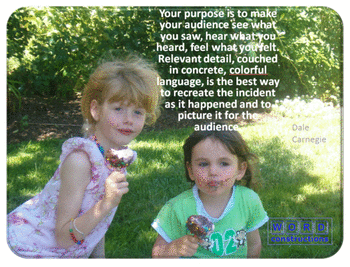
concrete language quote from Dale Carnegie

Avoid managerial language

In the words of Don Watson, “telling people requires language whose meaning is plain and simple. Managerial language is never this.”

Personally, I find ‘managerial language’ pompous a lot of the time and it makes me suspicious – why are you writing this so obscurely instead of saying it simply? Are you trying to trick me or hide something in the complexity?

A term like ‘populating the document’* is ridiculous! I interpret it as ‘filling the space’ or ‘adding fluff’ to make the document longer – remember those school essays with a minimum word count? it does nothing to promote your message and wastes everyone’s time so where’s the point?


* ‘populating the document’ was apparently used in a Black Saturday hearing by someone who had been ‘value adding’, ‘messaging’ and ‘communicating the likely impact’ to the people of Victoria.

Why alienate your audience?

I have just finished reading a book my daughter has read a few times. I was actually keen for her to read books by this author as she is Australian, writes about the meeting of cultures and seems to give a positive outlook to teenagers.

Now, I’m not so keen.

I actually found parts of this book (and admittedly it was her first) unsettling – and I’m unlikely to read another. by this author.

Writing about Melbourne

Australia has it's own culture

Australia has it’s own culture and terminology

The book is clearly set in Melbourne – the characters live in Camberwell, eat Vegemite, visit Lygon St for pizza and gelati, Acland St for cakes and belong to the Debating Association of Victoria (DAV). All those details are named and a theme of the book is a girl finding her identity as a ‘hyphenated Australian’.

So why does she ‘catch a streetcar’ to a ‘mall’ with her ‘mom’  wearing ‘flipflops’ or discuss clothing choices for a 58 degree day or ‘keep to the right’ when skating at St Kilda beach?

I’ve never caught a streetcar or worn flip flops in my life, but have been in many Melbourne trams and often worn thongs. Australia is metric so her 58 degrees farenheit would be known as 14 degrees (ah, now her comments about the girl being under-dressed make sense!) and if you stick to the right on our roads and paths you’re likely to get arrested if not killed!

Consider your audience

I often read books that were written for other countries, including the USA. I mentally ‘translate’ them into my experiences. So someone is facing a difficult left hand turn in the book and I picture it as a right hand turn to understand the context. I read ‘mom’ as ‘mum’, ‘color’ as ‘colour’ and struggle over imperial references.

That’s okay when I’m reading an American book.

I resent it in an Australian book.

If you are sharing an Australian experience with readers, make it authentically Australian by using Australian terminology and spelling. To do otherwise alienates your Australian audience.

Maybe her purpose was to write for the American audience because it is larger. Then why make it so clearly about Australia? Why insult Americans to say they can’t read a book and ‘translate’ terms into their context?

In a book trying to show how cultures are different but can co-exist, I found it uncomfortable that she didn’t stay with the Australian culture. It felt hypocritical. And that she was demeaning Australian culture.

Back to business…

You may not be writing books about cultural clashes, or even in a business that has much cultural diversity to deal with, but the point is the same.

It’s important to know your voice and stick to it.

To know your audience and understand it – not just what they can understand but what could be insulting or offensive.

To really think about what you are communicating between the lines.

To realise that the USA is not the world and that it’s ok to do things in a locally appropriate way instead of copying the American way by default.

mind your language and fly!

‘Communication is a causal factor in approximately 75 per cent of aviation accidents/incidents’ Russell Eastaway, an Air traffic Control training specialist in Melbourne.

I found that scary – every time we fly, we are relying a lot on the communications skills of pilots and ATCs (air traffic controllers).

It is reassuring in that we can teach communications to the relevant people but an article in Flight Safety Australia explains the bigger issue is probably adjusting their environment to improve aviation communications.

fly has multiple emanings

High reliability communication needed

Of the various errors that can occur in aviation conversations, three specifically relate to English (officially the language used in aviation).

Namely, ambiguity, transposition and phonetic similarity can cause major problems.

Did you know there an estimated 100,000 homonyms in English? Homonyms are words or phrases that sound alike but have very different meanings, such as there/their/they’re and your/you’re/yore.

100,000 opportunities to give a meaning you didn’t intend.

In business writing, we can look unprofessional or ignorant to use the wrong word. In aviation, we can say the wrong word and result in a major crash.

Although the consequences may not be as dire when writing, just an awareness of how easy it can be to make mistakes in English can remind us to proof read and get help with our communications. And take the time to learn how to spell various homonyms.

People working in aviation are given training in English and  former Emirates head of human factors, Surendra Ratwatte, adds that such training should be given to native-English speakers as well. English speakers need to avoid slang and vernacular use of words to communicate clearly, especially with people less familiar with English and local expressions.

Again, business writers can learn from this by avoiding terms and phrases that may not be recognised by the entire audience.

The point is not the words or language used but that the message is understood as intended.

Do you think your writing could be good enough for people to risk their life on the message getting across clearly?

A new way to get creative!

We’re all creative, it just gets a bit lost under all the stuff we have to do as adults.

I think it’s sad that so many people say “Oh, I’m not creative – can’t draw a thing”. Creativity isn’t about being able to draw (well, not exclusively about being able to draw!) and certainly isn’t about doing things to some external standard (who’s to say the drawing I made for fun or to capture a memory isn’t any good? It may not sell for millions or get an art critic’s approval, but that doesn’t mean it’s no good for me.)

Creative just means being able to think in different ways. It’s useful for problem solving, innovation and having fun as well as for creative pursuits such as drawing, writing music and knitting a jumper.

I even think you need to be creative to write well for business materials – it’s not just fiction writers who use words and ideas creatively.

So I believe in doing things to encourage creativity – I try for myself and my children.

And I could write heaps more on developing creativity!

Song writing makes you creative

Yesterday, I had lunch with my young children and somehow we got onto rhymes and songs. As you do with two and three-year olds!

My son then challenged us to write songs. With rhymes. On topics he chose.

All while thinking of a tune to put the words with.

It wasn’t easy – and my songs wouldn’t win any awards or go platinum, but it was fun.

It also woke me up and I returned to my computer fresher and with great ideas. Getting creative sparked my brain into being more creative.

Try writing songs for yourself…

You don’t have to have a three-year old urging you – just spend five minutes writing some songs. And singing them, of course!

topics in creative song writingSome of the topics I was given yesterday were…

  • doctors and the sick people
  • cows eating grass
  • potatoes eating yoghurt, potatoes eating carrots
  • a cat with sticky tape

At worst, you’ll have a laugh and a change of pace. At best, you’ll be more creative and think of new ways to use words.

Feel free to share some of your lyrics in the comments, too, to give us all a giggle and some inspiration!

Are you brave enough to run this as an activity with your business team?

Why link internally when guest blogging

Last week in a twitter chat, I gave the tip of linking to relevant posts at the host blog within your guest blog posts.
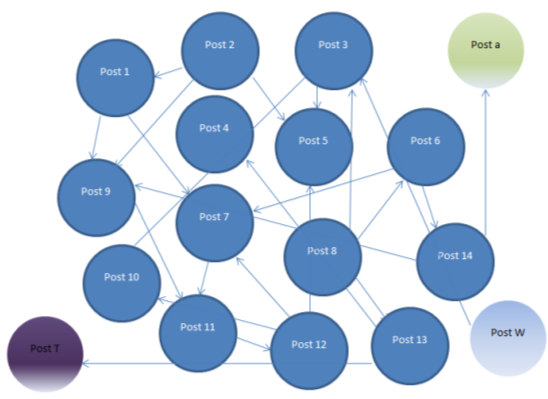
interconnections between and within blogsThe question, of course, is why that is important.

  1. some may call it sucky to do something nice for the host blog, and I can see why they would, but I see it as building a relationship of doing nice things for each other – it greatly increases your chances of being asked to do another guest post and being remembered for other opportunities
  2. linking to other posts in the host blog shows you have sent some time on that blog which increases the chances of the host blog accepting your post but also has the potential to impress loyal readers of that blog
  3. many hosts want internal links in every blog post so will actually add them to guest posts – if you add them yourself you  have more control over the placement of such links and can choose which posts to link to
  4. having more internal links can help the SEO of the host blog – and the more traffic your guest post has, the better results you can expect so it helps both of you to include the links
  5. if the host blog shows track backs (ie the comment area shows incoming links to each post), the internal links you add give your post additional exposure
  6. by linking to another post, you are endorsing the content of that post to some extent, which adds weight to the host blog’s credibility. It also supports your ideas if the host blog agrees with you. So internal links build credibility for you both and increase the authority of the host blog, making links back to your blog worth more
  7. I’ve added it as number 7 but this could possibly be the most important reason of all – to build your reputation and credibility. The purpose of any good link in a blog post is to provide extra information or resources for the readers, and links to your host’s blog are no exception to that. By linking to relevant information, you are showing a generosity and desire to help your readers which builds a positive impression.

What do you think – have you ever noticed links to the host blog within a guest post? Did they add value to you and the blog?

 

Being nice with your guest post refusals

handwritten note of no thanksWhether or not you want them, as your blog gets older and more popular it is extremely likely that you will be offered guest posts for your blog.

And assuming you want to maintain a certain standard (in writing quality, content value and staying to a style and topic range), you will need to reject some, if not all, of those offers.

I’m not going to cover why we should reject posts nicely – or reject them at all rather than just ignoring them – that’s a topic for another day. And I’m ignoring obvious spam for this post, too.

Rejecting with respect

The key to refusing a guest post nicely is to be polite and respectful.

Even if the guest post is irrelevant to you or low quality, someone has taken the time to write a post and submit it to you. If they have really tried, they will have an emotional attachment to the post and your response.

How to reject professionally

  1. be polite
    • use their name with a greeting –  “Hi Sam”
    • thank them for their submission
    • don’t use derogative or insulting words
  2. show respect
    • show you have a reason for the rejection – it doesn’t have to be in detail but adding ‘we don’t accept guest posts’, ‘we only use posts on this topic’ or ‘your post doesn’t suit our style/audience’ makes the rejection less personal and lets them know how to avoid the same mistake
    • don’t be insulting, rude or patronising
    • write a proper response – a single ‘no thanks’ looks lazy and disrespectful so use proper sentences
  3. be positive where possible
    • if you list faults with the submitted post (such as if you like their information but want the writing improved before you could use it), start and finish with positives about the post

The rejection note doesn’t have to be long as long as it is respectful and makes sense – a greeting, one or two sentences and an ending is enough.

Example rejection notes for a guest post

Hi Sam,

Thanks for submitting your “how to treat frog fungal infections” post. It was well written, however, my blog only accepts posts on business related topics.

Kind regards,

Tash

Hi Mary,

I received your guest post yesterday, thanks. I won’t be using your post in my blog because it doesn’t meet the guidelines for guest posts.

Cheers,

Tash

Thanks Phoebe.

Your guest post, Measuring your social media ROI, was fascinating and well suited to my blog. However, I found it a little hard to understand at points and a couple of sentences seem to stop mid-idea. The questions you posed were thought-provoking so I would be interested in seeing a revised version.

Hope to hear from you soon,

Tash

Hi Bob,

While I appreciate you sending me a guest post I don’t think it suits my audience so I have removed it from my inbox.

Regards,

Tash


* image courtesy of 123rf

Checklist for finalising an annual report

Producing an annual report is a huge job – there are so many details to co-ordinate. Before signing off a final draft, I always get the following items checked at least once, often using different people for specific list items so they can focus and are more likely to spot any errors.

Annual report checklistchecklist for an annual report project

  • company data
    • ABN and similar numbers
    • phone number
    • address
    • online addresses
  • logo is present and used according to the style guide
  • contents page numbers
  • spelling (especially company, people and product names)
  • technical details (eg is it $36 per 100g or 100kg?)
  • figures and data (eg financial tables, returns data)
  • people in photos are named correctly
  • labels on images are correct and with the appropriate image
  • mandatory details are included (various industries have specific items that must be included)
  • images and graphics are appropriate for the brand and ok to use (copyright, model permissions, etc)

THEN

  • report flows from cover to cover (ie read every word in order)
  • check everything fits correctly (eg remove orphans and align page breaks)


If all the above have been checked thoroughly, your annual report is correct and can be signed off ready for publication.

It’s easy to rush through this section because time is running out nad everyone’s a bit over the whole project by the end. However, it is such an important part of the process and needs to be carried out diligently (such as having multiple people involved).

When planning the annual report process, I always allow a week and preferably two weeks for the review. Not only does this reduce the rush, it gives me spare time if changes are required and a second review becomes necessary.

Do you have a checklist for finalising an annual report or similar large project? Do you involve multiple people in the review process?