
TashWord
Tash is a professional writer who loves helping people communicate clearly and effectively.

You might think surfing the web, playing games online or deleting spam are some of the biggest time wasters in your business, but I suggest that fear may actually be the biggest waste of all.
Think about it – if you fear making cold calls, you will suddenly find time to tidy your desk, sort emails and check links on your website! Or fear of a big project may make you procrastinate submitting your application, so much so that you do a rushed job and miss out.
Fear means we don’t get tasks done, and they stay in our minds so we can’t focus 100% on other tasks either. Although I don’t always do it myself, lol, I believe that the things we fear in business are the things we need to do NOW so we can get passed them. That doesn’t mean we won’t be scared of them next time they come around, but maybe we’ll know we can survive them!
As Michelle says in her ShelDesign blog,“if we let fear control our actions, it WILL steal our dreams.” And losing our dreams is a huge waste of our time.
How do you manage fear in your business? Do you find fear of failure or fear of success to be a bigger issue for you?
Can you believe I just received an email about Christmas? And it’s only mid March!
Ok, it was a request to fill in a survey about Christmas in your business – a survey where the answers will be used to provide information to magazine readers preparing for Christmas. So it is reasonable to mention Christmas this early, but it still shocked me!
But it does raise the question – how soon do you plan for major events in your business? Not just Christmas, but Easter, change of seasons, new financial year, awareness weeks and so on that are relevant to your business in some way.
In business, there is a hope that in some way we can be the biggest and best so that clients will come flocking to us. And some businesses give into that temptation and make claims that are not exactly accurate, or even true.
Too much hype just makes people switch off, and being caught out in a lie or false claim does not build am image of professionalism or integrity. In other, these behaviours do not build a strong business foundation.
So before you make any claims, be sure they are accurate and that you have checked them out.
Be very careful using terms such as ‘best’, ‘most popular’, ‘biggest seller’ and so on unless you have statistics and research to back up your claims.
If you say you are the first – don’t just check that no one else has done it before, check that your wording makes it clear what no one else has done before. For instance, saying I run the first business directory in Australia is not quite the same as saying I run the first online business directory in Australia. Likewise, there may be two interpretations of some words – online support could mean forums, a mail group, an information site, chat room discussions or some combination of the lot. So you may be the first online forum but not the first online support group.
And remember, it isn’t just to maintain your image and integrity – if you stray too far from the facts, you may face legal issues, too.
A few days ago, I posted about the importance of checking presentation as well  as details of your content. Today, I am going to list the details I check for when reviewing a draft for a document’s design elements.
This list is in the order I think of them, not necessarily in any importance.
If you are happy with all of these details, you will be very close to the correct design for your needs.
Maybe its just me, but the business field seems to have more than its fair share of guru claims – that is, people claiming to be a ‘business guru’ or ‘marketing guru’ and the like.
Some people would think the guru title is a beneficial way to promote yourself and your business to the business community, thereby building a customer base and high profits. However, I think there are serious downfalls to the idea, and I would never call myself a guru; even if others were calling me a guru (and they aren’t as far as I know!) I would not use that on my website or in my marketing, at least because others may think I gave myself the title.
What do you think? Does someone calling themself a guru impress you so you respect what they say immediately? Or are you more cynical about them so that they have to work harder to impress you with what they say?
Would you call yourself a guru in your field (assuming you have a high level of knowledge)?
Last year I was fortunate enough to attend the first Business Mums Network Conference. I presented a workshop and in a forum at the conference, as well as being an attendee at other sessions, and found the entire weekend beneficial.
This year’s conference is a bit earlier so I have just finished a proposal to present again at this year’s workshop – I have already registered to attend anyway! I should find out later this month if my proposal was accepted so I will let you know what I am speaking about (I proposed more than one topic.)
If you can be in Melbourne in for 12 – 13 July for the conference, please make sure you meet me!
 It is important to keep track of the date and what is happening if you want your writing content (and other communications) to be credible and respected.
I heard a perfect example of this morning. As part of a news item in the 10 am radio news, the newscaster said “… will be announced later this month.” Of course, at 10am on the 29th February, there really isn’t much of the month left for things to happen in! It was probably a simple mistake (perhaps it should have been “… later next month…”), but it stood out more than the actual news itself.
While people can allow for small mistakes, and sometimes won’t even notice them, mistakes can change the impact of what you write (or say) and that can be costly. So remember to check:
Take particular care when you are writing something in advance. For example, if you write blog or newsletter posts weeks or even months ahead of publishing them, it can be easy to refer to current details instead of the relevant future ones.
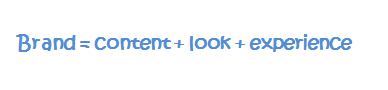
Branding is a big subject, covering how you use your logo through to how you give a presentation. But did you know that the words you use in documents, on websites and in presentations also form part of your brand?
For instance, if your brand is to be young and funky, you don’t want web copy that reads “In our experience, prospective partnerships are best developed through a commonality of interests…”
Some factors to consider to ensure your written communications enhance your brand are:
This can all come into preparing a style guide, too.
Recent Comments