
TashWord
Tash is a professional writer who loves helping people communicate clearly and effectively.

In an earlier post, I wrote about cuboree – a camp for Victorian cubs and leaders and the wind storm that hit the camp.
When they joins cubs, each child makes a promise which starts “On my honour, I promise to do my best” – and doing their best is one of the key principles we use to encourage and develop the cubs. Every week, the cubs also reaffirm their promise to do their best.
The cyclone that hit during cuboree gave the cubs (and their leaders!) a challenging afternoon as they were kept indoors under cramped conditions.
Leaders did their best to keep the cubs occupied – in the marquee I was in we found pencils and paper, folded paper planes, sang songs, told jokes and played a DVD as part of keeping everyone busy and happy. Leaders also did their best to keep fear away form the cubs by managing the risks for them and protecting them as much as possible – a number of times I saw leaders leaning over cubs to protect them from falling debris, and leaders escorted children who needed toilets rather than letting them face danger alone.
Camp cooks did their best to provide nutritious and interesting snacks and meals, despite lack of power and/or gas to cook with.
The police did their best to keep us safe and arrange for the most dangerous trees/branches ot be dealt with.
Camp organisers did their best to keep us and families informed, everyone safe and accounted for, and to get some people home early as required.
But above all, we all were so proud to see the cubs do their best in trying circumstances.
Yes, cubs did ask “will we be in here much longer? when can we go outside? where will we sleep tonight?” and similar questions, but I did not hear one complaint from them. The cubs devised their own games and activities, moved around and spoke to cubs from other packs and places (they found it a great opportunity for badge swapping!) and did whatever was asked of them. They even queued for toilets trips without making a fuss. Sitting on the ground eating salad rolls for dinner didnt even raise a complaint.
The cub’s behaviour made difficult circumstances bearable and we were all proud of them. It was also inspirational to see them behave so well – it made it easier for us to do our best, too.
Next time you feel like doing ‘good enough’ in your business, take a moment to think about those cubs and ask yourself if you are dong your best in the circumstances or not – and what you will do about it if the answer is no.
Earlier this month I wrote about one aspect of business card etiquette (i.e. not just giving cards out to people at random), but there are other aspects to this etiquette.
I came across a blog post that discusses how different cultures have different expectations about how business cards should be given/received. It is interesting to note these differences and I think it is respectful to use these different ideas when dealing with international people.
However, I think many of those differences can be used routinely in Australia, too.
For instance, in Japan it is considered rude to give a card with one hand – they pass it over with both hands and presented in a way that the other person can read the card as it is given; the other person then carefully takes the card, reads it and gently places it in a pocket. Ok, giving a card in two hands and bowing may raise some eyebrows between two Aussies, but but why not show respect and read someone’s card as they hand it to you? Why not make sure your card is the right way up when you pass it to someone? And I think etiquette in any language is to place the card carefully somewhere once you have it – don’t shove it in somewhere or screw it up/fold it/whatever.
I also thought it interesting to note that a multi-lingual card (or different cards in various languages) is almost a must in some cultures. Personally, I only deal with English speaking cultures (because there’s no way I could write professionally in another language!) so an English card is sufficient, but I see the value in using another language on the reverse of my card if I was to frequently deal with people in that culture. It shows respect but also makes it easier for them to understand who I am and how I can help them.
Do you have separate cards or techniques for dealing with international business dealings?
Happy writing!
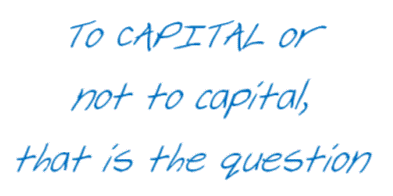
Pardon changing the Bard’s words, but this is a question that needs asking much more often …
I suspect the increased use of SMS and chat shorthand is a major factor, but it seems that many people aren’t sure about when to use capital letters in their writing. So here is a quick summary of when to use a capital letter:
Capitals letters are sometimes also used within names (e.g. AvSuper, MacGregor), in scientific terminology (e.g. E. Coli, Eucalyptus, cyclone Tracy) and where two words have been abbreviated into one (e.g. eBooks, eLearning.)
There are variations in some of these rules, especially if you travel to another country but using these guidelines will avoid any major errors! Or call upon someone to check your writing for you – errors that requires conscious effort for you to find often are quite obvious to others, especially to someone like me who spots such things without trying.
Edited to add: I came across a fun poster with the basic capital letter uses, which is great for kids and anyone struggling to remember these rules.

* The use of a generic noun as a proper noun requires a capital letter, too. So while mothers is written in lower case, a capital letter applies in the following sentence: Mary said “Hello Mother. How are you?” Likewise, you may write about a library (generic) or the Ashburton Library (specific).
I just saw this fantastic video and felt I had to share it…
It is about leadership (relating to a Californian company, but that is not noticeable until the end) and how we can all make a difference to our world; but it is also about being a decent human being and ending each day satisfied with ourselves and our lives.
Thank you to Donna-Marie for sharing this in her blog for me to find, too.
I hope you find it as inspirational or encouraging as I did.
For instance, someone I know recently ended a project because his client gave him insufficient and contradictory information. This client had prepared a brief but work done to match that brief was rejected!
 Obviously communication is a two-way thing but if you make your needs straight forward it is more likely a supplier will give you what you want.
1. specify anything mandatory – e.g the logo must always be on a white background or the newsletter must be ready by the 1st of each month
2. explain your ideas – a rough sketch is ok as long as it is labelled
3. avoid jargon unless you are sure the supplier understands it the same way you do – that includes using their jargon if you aren’t sure of it yourself!
4. write or talk as if they are a customer – clearly, concisely and politely.
Have you had client projects where poor communications made the project a dreaded chore instead of challenging and interesting?
I remember some years ago, all employers had to provide training for all of their employees. Yes, some employers and employees didn’t take it seriously and some silly courses may have been undertaken, but I still like the concept of people constantly learning.
As an employer, training staff means they are learning and growing so will be able to their jobs better, and they will respect and value the fact that you care enough to provide such training.
Kylie at Tilda Virtual wrote about the importance of setting a training/development goal and sticking to it, and asked what our goals are in this area for 2008.
To be honest, I haven’t developed a training plan as such for myself. I am going to the Business Mums Conference in July, I read business blogs/magazines/blogs/articles when I can, and I look out at networking and other business events for ones that are relevant to me. Oh, and I am working towards my certificate IV in business (frontline management) and certificate IV in leadership support later in the year, although that has more to do with being a cub leader than a business owner!
Of course, the information I learn about each client, their business and sometimes their industry is development for me, too, but much harder to plan (who knows what industry my next new client will work in!) and not always directly transferable to other work I do.
But there has never been a rule that says business owners must provide training and development opportunities for themselves… And yet this is the group who probably has to cope with the largest number of tasks in different areas.
Kylie has me thinking now, so I will make some time to think of what skills I can and will develop this year. I know I won’t put a huge amount of time into training this year with a baby on the way, client work and family commitments!
How about you? Have you planned any personal development this year? Have you timetabled for it so it won’t slip aside when more urgent tasks arise?
I recently read the following in a book: “As Linda came back into the room, she saw Claire was back from lunch. She smiled at Marie then called Bill.” The question is, who smiled at Marie and rang Bill? The author meant Linda but grammatically the ‘she’ of the second sentence is Claire.
In business writing, that sort of confusion could lead to misunderstandings about who was to do certain tasks, or just annoy the reader so they will take their business elsewhere. Use a name or title to start a sentence for clarity.
*For the sake of clear communication, a pronoun is a word that can be used instead of a noun – for example, she, he and it are common pronouns.
At the end of March, I wrote about joining 4,500 scouting people at the 5th Victorian Cuboree. I’ve been back home for a bit over a week now and am still exhausted from it, but figured it was time to report back!
The camp was a lot of fun – we were busy with activities all day and entertainment at night, lots of fun and walking around in the bush (well, the bush with lots of people and tents anyway!) We arrived on the Monday and came home (late) on the Friday.
We had some extra excitement with massive storms on the Wednesday – the worst to hit Victoria I heard, with winds hitting 130kms an hour! We were in the area of Victoria worst hit so we certainly were aware of the storm, lol. We spent nearly 8 hours in a strong marquee (rated to 90 km winds) with over 700 cubs and leaders, plus support staff – the kids coped with it really well which made the experience manageable. As leaders, we were really proud of how the cubs behaved well and accepted the limitations forced upon us – they lived up to their honour and promise of doing their best. In our pack, we had one tent damaged beyond use and two tents we considered at risk from a branch so we sent 12 of our cubs (plus some leaders) to sleep in the marquee although the rest of use slept in our usual campsite.
The entertainment consisted of a group of four wanderers looking for the 2010 Australian Jamboree – finding the 1908 jamboree, Rio’s carnivale and cuboree instead! Many of the cuboree cubs are now looking forward to attending jamboree.
I enjoyed being with the cubs – most of whom I didn’t know beforehand, plus three from my home pack – and we had a great bunch of leaders in our pack, too. Will I go again? I’d definitely consider it! Seriously, if the circumstances were right for me personally, then yes I would go again – but would ensure I had some extra time off to recover afterwards!
Would I send my own kids to the next cuboree (age limits allowing of course!), most definitely – I think it is a great experience for them.
Have you ever been to something like cuboree? Is it something you look back on fondly?
And I even learned a few things that may just come in handy as a writer and business owner 🙂 Watch for upcoming blog posts!
Recent Comments