
TashWord
Tash is a professional writer who loves helping people communicate clearly and effectively.
Not all websites have a FAQ page, and not everyone things positively about FAQs, but I think they are worth adding to a business website.
 In very simple terms, it helps people find information about the business and/or products and services available.
Some of the information just doesn’t fit very well elsewhere on the site and others bit are important enough to justify repeating.
I know when I am looking for specific information, I often go to the FAQ page, and the lack of a FAQ can be really frustrating as it leaves you searching the entire site.
Having a FAQ page
Of course, the FAQ has to be worth visiting or it can undo all the benefits – but we’ll cover what’s in a good FAQ page another time!
*Image courtesy of icreative3d at 123rf

An FAQ that makes someone laugh is a positive for your business
Looking at options for some software, I viewed a few FAQ pages lately (FAQ being Frequently Asked Questions).
Some FAQs are better than others, and some were great – informative and easy to understand.
Long, dry answers make FAQs boring and hard to read. FAQ pages based on plain text are also boring, and hard to find relevant information.
Good FAQs visually separate questions and easy to read.
An FAQ page is full of facts, otherwise what’s the point of having it? But that doesn’t mean you have to make it all staid and boring.
Here are some examples for amusing FAQs I have spotted:
Q: How do I invite someone?
A: The basic invitations are simple SMS messages. Naturally, you have other options to bring your friends here. Try sending them a download link via any other messaging service: email, Facebook, WhatsApp, an actual telegram — you name it.
Q: Will you have ads? Or sell my data? Or steal my beloved and enslave my children?
A: No.
Q: will these faqs ever end?
A: well it always has before!
Q: You didn’t answer my question. How come?
A: Probably because this FAQ was written by a marketing person. Please ask us your question using our contact us form.
A bit of humour and lightness makes the whole page easier to read. Thus, they’re more memorable, too, and every business wants to be remembered.
How can you add some humour to your FAQ page?
*Image courtesy of Frugo at 123rf
I came across this great infographic outlining why children need to be able to read.
As well as being a good message in itself, the infographic also supports Buk Bilong Piknini (a charitable organisation funding books and reading programs for children in Papua New Guinea).
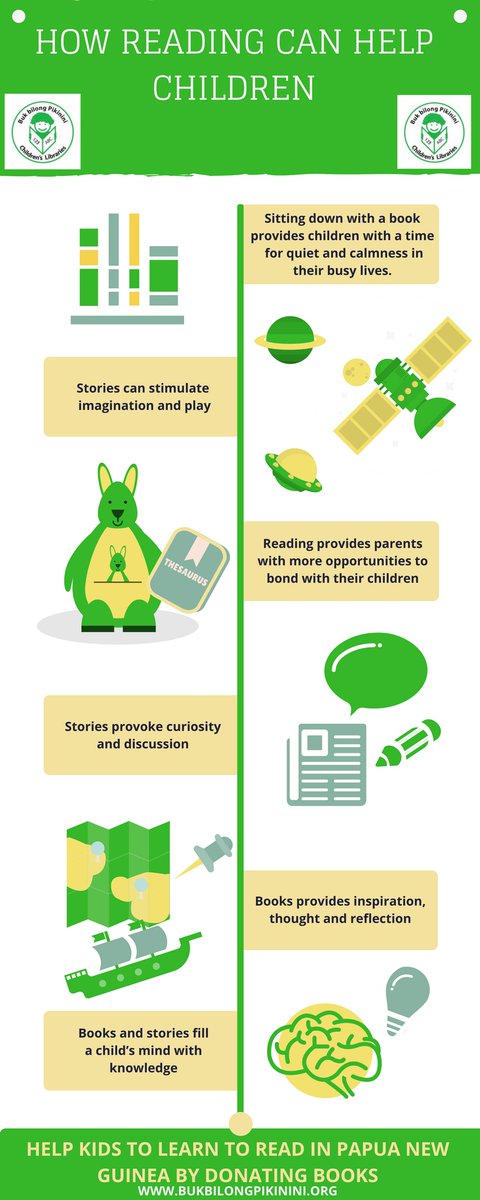
What do you think – why is it important we encourage children to learn to read, and then read some more?
I would also encourage everyone to help ensure our children are literate – whether by donating to groups such as Buk Bilong Pikinini, helping at schools or giving books as gifts, every bit helps.
I frequently help at my children’s school by listening to children (usually not my own!) read and helping them build the skills of sounding out new words, ensuring the words make sense and getting a full understanding of what they are reading.
What have you done to help children (or adults for that matter) learn to read and enjoy reading?
The sign was big, but on an angle for most people
We attended an indoor play centre recently for a child’s birthday party.
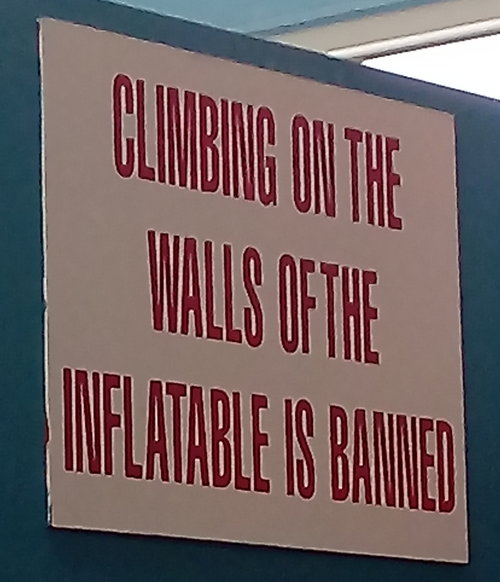
I spotted a sign on a wall opposite an inflatable slide, within the enclosed rock climbing area, that I think was missing the audience.
Where the sign was
The sign was up on a wall and printed in a large font so it should have been useful.
However, it was on an angle that made it hard to read except for by children rock climbing.
Surely putting it above the inflatable would have been more effective as it would be visible at the time you would be considering climbing up the forbidden walls.
What the sign said
Remembering this was in an indoor play centre where most of the patrons are under eight years of age, the sign was not written for the audience.
Apart from the very young children who can’t read at all, many youngsters would not be up to reading ‘inflatable’ and many would not know the word ‘banned’. Even for those who can understand the sign, it will be most effective if people get it instantly, without having to think about its meaning.
The inflatable is more known to children as the big slide, so that is the type of language they would be better using.
A much simpler sign would be “Do not climb up the slide”.
I think this is simpler and more effective, but also has a second meaning as it tells children not to climb up the slide itself, as well as not climbing on the support walls.
It is always important to know who you are aiming your communications at, and aim for clarity more than cleverness.
As a writer and communications consultant, I spend much of my working time at a computer and it’s not too glamorous, so it is nice occasionally to do something more interesting in the name of work!
Last night is a perfect example as I went to a function with a client (as their Communications Manager).
The Australian Women Pilots Association (AWPA) held their annual conference in Bendigo this year, so I went to their gala dinner and had a great night. In particular, it was great to see a male dominated industry have a strong female element supporting each other and encouraging young women to enter aviation.

Some of the highlights of the night were:
I would love the opportunity to interview many of those women and write their stories. As a collection, I think it would be interesting, inspiring and a historical reference and record.
Do you know any female aviators? Or been inspired by any of their stories?
It’s hard to choose who to vote for if the candidates communicate poorly.
Throughout Victoria, we are about to vote for our local councils.
Unbelievably, in my ward, there are 21 candidates for us to choose from to select 3 councillors!
This is a lot of people to consider while trying to choose my vote and is a bit overwhelming but it is useful from a communications perspective as I can see big differences in their statements.
So, putting aside politics and any particular platforms these people are standing for, here is a summary of the candidates I can choose this week. I am basing this on the official statements prepared by each candidate that were sent to us by the Electoral commission, and I am not using anyone’s real name!
George – has a personal dislike to something other residents are doing so wants us to vote for him to stop that behaviour.
Fred – is retired and is standing to get better deals for older residents.
Sally – is mum to young children and will fight for better services for new mums and for families.
Communications – all three of these people have written a reasonable statement that is easy enough to understand and sound like reasonable people. I just find it difficult to trust someone who is obviously going into council for their own best interests.
Jenny – states she is affiliated with a major political party but lists various local issues and experience to show relevance. The second half of her statement is more formal and is about policies, sounding much more like a politician than a local councillor.
Ed – does not state any political affiliation but the statement sounds formal and like a federal election campaign piece. It is not law that candidates state they belong to a party (and follow part lines) but this is a contentious issue of late. All sounds pretty perfect really…
Rachel – the current councillor and someone who is involved in our community – and the only one most people I know have met or seen around. Her statement shows her passion, is easy to understand (both through competent writing and using approachable language and style) and ends with “I ask you to vote for me” (rather than demanding it). She covers a number of issues.
Angus – a young person who grew up in the area and covers a number of issues in his statement. Again, it is well written and readable.
Communications – there are others in this group but all of them discuss a number of issues in clear English and declare no connection with a political party.
David – started his statement with “7 years house designing in Shanghai; Melbourne.” No, I don’t know what that means either – and as he works in the IT industry and is standing for a council role (not a council planning job!), it makes little sense.
David’s statement has many examples I could use in my bad writing posts – “Experience in retails…Involving security issue with PM…I pointed city apartment…Successfully suggested VCAT improve hearing procedure with writing hearing” {the lack of final full stop is copied by the way!}
Due to his poor written communication, I don’t understand what he is standing for – even when I can guess the meaning of a sentence, I can not be sure if he is for or against that issue!
Simon sent a SMS to some people, outwardly to remind people of the need ot vote, but everyone I know of (and others according to local media) were irritated by this message. Simon came across as pushy and people felt their privacy had been invaded by these messages sent to private mobile phones.
Other than the SMS, Simon fitted into group 2 but I know at least two people who voted him as number 21 purely due to the SMS. As I have said at various times, being aggressive and overly confident in communications often backfires (with Australian audiences anyway).
Obviously, there are other ways these candidates can promote themselves to the voters but let’s limit ourselves to these statements. Because that is the only way most people in our area get information to make a choice in the elections.
There is a wide selection of writing styles – from someone who does not know how to write in English, through those who write good conversational English, to those who write formal, professional pieces. Just this choice of style will have a big impact on how voters will perceive each candidate.
Given there are 21 candidates (and apparently some areas have many more than that!), many voters will not read the statements in depth nor do other research. So the style and approachability of these statements is critical for their success.
Based purely on their communication skills as described above, who would you vote for if you lived in this area?
Who would you not vote for? This is possibly an even more important question for anyone trying to learn how to communicate effectively to get positive results.
I’m sure there would be many answers to this, but generally we mean being able to effectively give our message to another person (s).
That being the case, how do we classify something as good communication and set rules for good communications?

Good communication requires good listening as well as using good speaking techniques.
While there are some basics that help with clear communications face to face, such as making eye contact, not interrupting and being polite, such things are not always possible and we may need to work around them.
Today I came across a blog post about communicating face to face and I was surprised and somewhat horrified by one of the tips given. Basically, the writer suggested that you should avoid stammering or stuttering as it can hinder clear communication. He did not allow that it was unavoidable for some people and implied it was just a behaviour they were choosing to exhibit.
There are impediments for some people in conventional communicating – blind people can’t meet your eyes, deaf people may focus on your lips instead of your eyes, someone with Tourette’s syndrome or Asperger’s may seem impolite and various people (including stammerers) may be harder to understand.
And yes it may be easier for us if those people did follow the ‘rules’ of good communicating, but they can’t so we have to learn to be patient and understanding. I found it insulting that this writer included ‘stop stammering’ as a means of communications.
Have you come across examples of people setting communication rules that are excluding certain groups of people? Or people with rigid ideas of what good communicating look like?
 “It’s not fun to reread everything but you have to edit your work. I’ve written long essays at Uni, thinking they were good, but when I edited them, I found some bits just didn’t make sense. Sometimes your brain takes a little rest and you don’t write as well.”
That’s what my son’s grade two teacher said this morning as she led a class on editing.
The ability to edit what we write is an important communication skill. For instance, if I wrote an invitation for Thursday 10pm, I may be a bit lonely at 10am when no one turn up because I hadn’t checked what I wrote in the invitation.
While it can be much easier to edit someone else’s work as it is fresh to us and we don’t have an expectation or memory of what was to be written, there are many times when doing your own editing is necessary.
Technically, learning to read and write gives us the skills to edit our work (for example, you could recognise ‘siad’ was incorrectly spelt).
However, as I saw in the classroom today, being given direct tasks for editing is an effective way to understand and undertake editing.
Each student was given a checklist of tasks to edit a piece of work they wrote last week.
The group I worked with, went through the list item by item to improve their writing. When I edit, I probably do multiple steps at once but doing one at a time is simpler for children. I also think that doing it step by step actually makes errors easier to spot.
So the checklist today was:
Why not follow this list next time you have to edit something?
Just because this list uses very specific terms taught at our school (and others!), here are a few tips…
I liked that the teacher today actually told the students to get help with editing.
First, she suggested that if they suspected (or knew!) a word was misspelt they could check the spelling by using their dictionary or asking a classmate.
Then, she also suggested that for any sentence they were unsure of, it was ok to say “Hey, Tom, does this make sense to you?” and get someone else’s opinion.
So even if you don’t get someone to edit your writing for you, you can look up or ask for help on specific sections of your work. If the writing is of importance, the editing help is really worth the effort.
So you have a product and customers have to mix it in some way, and you want to make it easy for them to get good results. What are your options for doing this?
This is to follow on from my post on tile adhesive instructions being less than ideal, and I thought I’d explain some ways to make mixing instructions easier for your customers.

You may not need scientific precision measurements, but clarity is critical in making the right mixture.
Yes, you could copy the tile adhesive company and give very basic instructions. And that would be fine for some of your customers.
Or you could aim to help the majority of your customers with more detailed, clear instructions as they will be happier and get better overall results. And happier customers will come back and/or recommend you to others.
Better instructions could also mean fewer calls to you asking for help, too.
Depending on your product and audience, you may be able to use one or more of the following options.
Obviously, the simplest approach is giving exact measurements like a cake mix packet – ‘add one egg and 1 cup of milk to the cake mix’.
Of course, it is best to avoid ambiguity and use clear measurements. For example, 250ml is safer than 1 cup as non-Australian cups are not 250ml.
When you have a packet and people are likely to use part of it each time, a ratio can be a handy measurement tool.
For instance, ‘add two teaspoons of fertiliser per 3 litres of water’ can be used by someone wanting 3 or 30 litres of fertiliser. And ‘mix a 1:1 volume of powder and water’ is easy to convert to any quantity of the mixture.
When you provide a large quantity of the product and people are probably going to use it in batches, it is important to give them realistic numbers to work with. For example, no one is going to use a whole box of washing powder in one go so why bother saying ‘tip the box into a 7,000 litre washing machine’?
Even if you do provide a ratio of components, some examples or a range can be very useful for a consumer.
A range could be in a table form:
| powder | water | area covered |
| 1 cup | 2 litres | 1 m2 |
| 2 cups | 4 litres | 2 m2 |
| 5 cups | 10 litres | 5 m2 |
Or as text ‘To cover a large area, mix the entire bag with 6 litres of water; to cover 1m2 area, mix 1 cup with 2 litres of water.’
Sometimes an exact measurement isn’t feasible, but this can be hard for a user to understand.
Instead of saying something like ‘use one to two cups of water’, it is clearer to write:
– add one cup of water and mix
– slowing add more water (up to 1 cup) until the mixture runs as slowly as honey
or maybe you can add notes like ‘Add 1 cup of water and mix. Note that in high humidity or days over 35°C, an additional 1/2 cup of water may be needed.’

Recent Comments