
TashWord
Tash is a professional writer who loves helping people communicate clearly and effectively.

The biggest carbon tax cost impact for most Australian businesses will relate to increased utility costs – power and gas in particular. And the flow on of suppliers having to cover their increased utility bills.
Energy Action has an online calculator to help you estimate the impact on your business – just enter your current electricity and gas bills to get an estimate of your bills for the next 3 financial years.
The carbon tax is coming, power bills will increase and businesses have to deal with it.
In the fight to keep prices down but profits steady, I think adding green practices to your business can help. That is, if you can implement some changes that reduce your power bills, the carbon tax will have less impact on for expenses so you can maintain prices and profits.
As a test, I reduced my electricity consumption by 50 kWh to save $16.93 per month in 2013 and $18.71 per month in 2015. Prices jumped $3.55 per month in that period prior to my reduced consumption.
{I made up the consumption numbers just for interest and used Victoria as my state.}
Saving in business power
How can you reduce your power consumption by 50 or more kWh?
There are many ways to cut your energy consumption, but some I have done or am looking at include:
What other ways can you minimise the impact of the carbon tax on your business? Will you try to minimise the impact rather than pass on increases to clients?
There are two main reasons people visit a website – they want information on a topic or they want information about the business behind the site.
So why do some sites avoid sharing anything about themselves?
Add an about us page to your website and blog
 As Chris Lake wrote, an about us page “is surely one of the only true rules of doing business online. I can think of no good reason why you wouldn’t have one.”
An about us page can be very simple but it can make a huge difference to people thinking of doing business with you.
For a stand alone blog, it lets readers know who is writing the posts – for instance, is it a business or an individual, is it by an expert or someone learning the topic, or is the blog focussed on a specific topic or just a collection of ideas.
For a business website, it can build enough credibility for me to do business with you – or not.
How ‘about us’ can build credibility
I have an about us page on my website and as part of my blog, even though they are on the same domain, so it is easy for people to read about me and my business. I wonder if I’m brave enough to ask if you have read either of them!
How important is an about us page when you are assessing a potential supplier or service provider?
While clearly pronounced differently, bizarre and bazaar are similar enough to cause confusion. Although it may simply be the spelling of each that confuses, rather than mixing the two up…
Bazaar [noun]: a marketplace with miscellaneous stalls and shops, especially in a Middle Eastern country; a shop or market selling a mixture of items; a stall or market where goods are sold as a fund-raising event
Mireille strolled through the bazaar while waiting for friends in Lebanon.
Bizarre [adjective]: odd, obviously out of the ordinary and different, far-fetched, unexpected
The teacher’s outfit was bizarre – a mix of cultures, colours and fabrics like I’d never seen before.
 Most annual reports contain the same general information year after year.
Whether it is an introduction, history of the business, outlining products, naming directors or key staff, there are sections of an annual report that don’t change much over the years.
Repeat the wording?
The fastest option therefore is to use exactly the same wording in those sections every year, just changing small details as necessary. The freshest option would be to rewrite all those sections.
There are pros and cons to both options, such as:
So what do you think – would you be unhappy getting an annual report that was largely the same as last year’s? Would you even notice?
The editing of guest blog posts is a perfect example of a blog policy.
It gives the host blog some control over the standard of posts accepted. The host blogger can accept great post ideas and make sure they read well.
Specific policies are more effective
Many blog policies include something like
All guest blog posts may be edited before publishing.
As a potential guest blogger, that makes me nervous. What will they edit? Will they tell me they have edited it before it is published? What if their edits include poor grammar/expression so it looks like I made those mistakes?
As a host blogger, I would feel uncomfortable taking advantage of such a policy and making huge changes to someone else’s post. I would also start to think it would have been easier to write my own post on the topic!
I prefer a more specific policy, such as
Guest blog posts may be edited for spelling and basic grammar.
For full transparency and relationships building, I would add an extra sentence, too:
We will get your approval on any edits other than typo corrections
If you’re submitting guest posts, which blog would you choose if the only difference was in their editing policies?
I spent a lot of time yesterday running around and throwing balls at kids (mostly during games of poison ball with Cub and Joey Scouts) so this pair of words came to mind for today’s Monday Meanings. It’s certainly a pair of words that would look very strange when used in the wrong way.
Throne [noun]: a seat reserved for use by a monarch; a large, ornate or imposing seat
Everyone stood as the Queen approached her throne.
A giant throne dominated the grass near the car park.
Thrown [verb – past participle of throw]: having propelled an object through the air, generally by an abrupt arm or hand movement; caused a fall; confused (common speech use)
The ball was thrown five times before Jack could catch it.
The cowboy was thrown from his horse when a snake crossed the path.
“I was thrown by the word buoy in that sentence,” she said.
If you need a way to tell these words apart, remember that a throne is for one special person.
Have you ever seen these two words misused?

Which option will be our future?
I have just read a great article* by Amy Birchall about social media being used to predict the future.
A researcher at Illinois University, Kalev Leetaru, was able to ‘predict’ events such as the Libyan revolution, Osama bin Laden’s location and the Arab spring revolts by monitoring conversations and trends on Twitter. (This made me think of the TV show Person of Interest which is based on a machine predicting the future!)
Extrapolating from that and other observations, the article discusses how social media can be used in many fields to predict things – giving warning to health authorities about epidemics for instance could be very important. Obviously, marketers and advertisers are interested by this as they can predict trends and position themselves accordingly.
It has also pointed out how valuable it can be to target the right (read influential) people can be. The example given was to immunise 96% of people for community immunity – or immunise the most connected 30% for similar results. In business terms, work at promoting yourself to 96% of your market, or to the 30% that influences the rest of the market.
With hash tags and various data monitoring and mining platforms available, it is possible to use social media to research your market and tailor marketing to suit. Have you used social media to decide on a strategy or campaign? Do you think it helped you make good decisions?
* I would love to link to the article for you but I can not find it online – Management Today does have a website and lists a number of articles but not this one unfortunately. I could upload a photocopy of the article but that would breach copyright so I won’t!
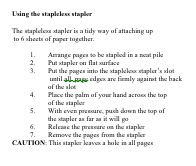
Short, practical procedures work
If you have gone to the effort of creating some procedures, you want to have your team make use of them.
Let’s face it, many of us have tried putting together an Ikea unit before reading the instructions – often to use them later. But we don’t want that happening to the procedures we spend time on writing to benefit our businesses.
Here are four tips for encouraging use of your procedures:
What makes you use any procedures you find helpful?
Despite the similarity in spelling for today’s words, they have very different meanings.
contemn: [verb] scorn, disregard, feel contempt for
He seems to take price in his ability to contemn new performers.
contemplate: [verb] consider, envisage and observe consistently about a likely or probably action or outcome
A wise person will contemplate all options before making an important decision.
The word contemn is not used a lot, but some people question whether it was the intended word in line two of The Ode (part of For The Fallen by Laurence Binyon and used in ANZAC and other remembrance services around the world):
They shall grow not old, as we that are left grow old;
Age shall not weary them, nor the years condemn.
At the going down of the sun and in the morning
We will remember them.
It appears that Binyon did intend to use the word ‘condemn’, but ‘contemn’ would also fit in there. Which word gives the better message to you?
 I spent the weekend
Recent Comments